SUMMARY
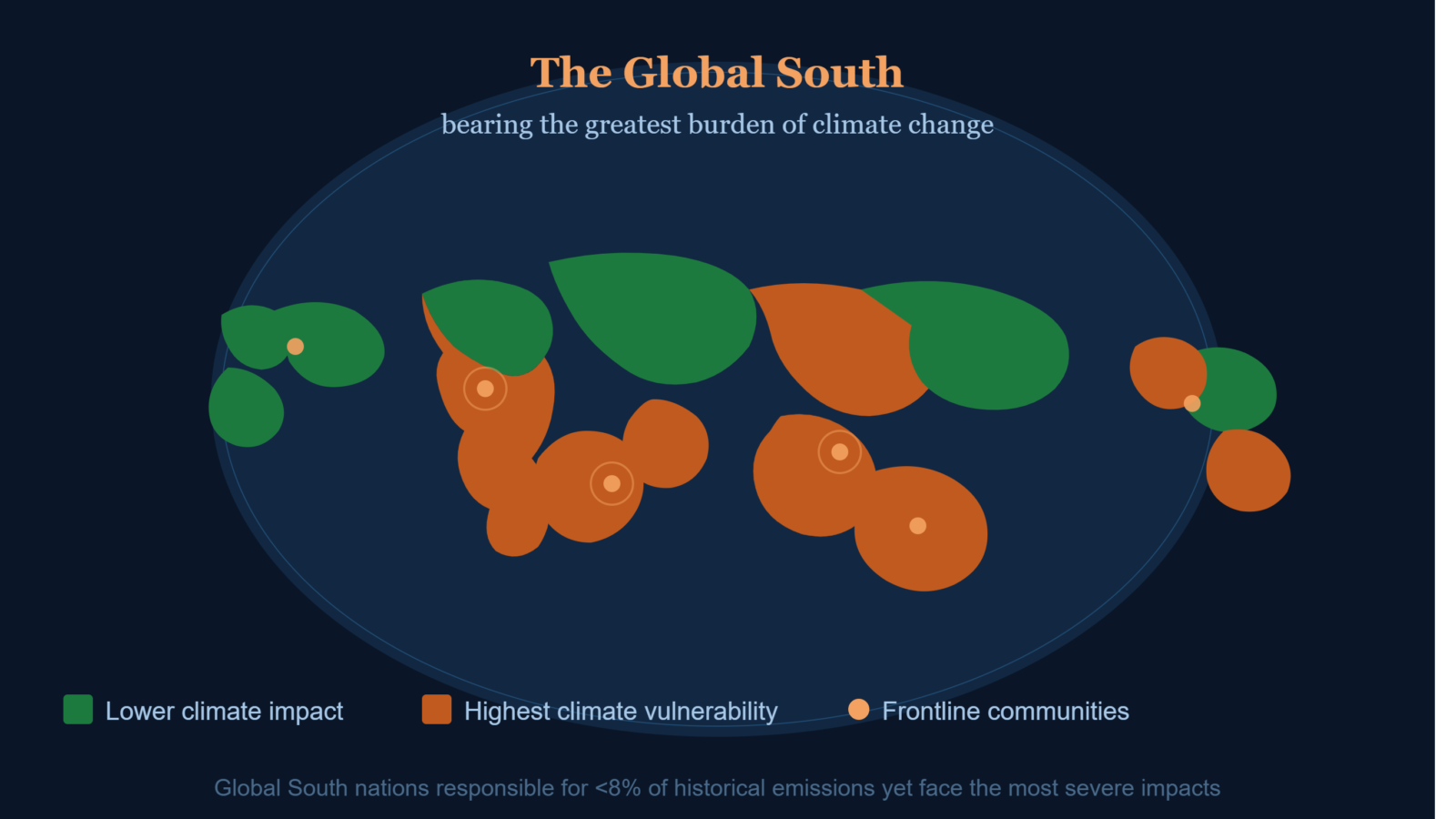
The nations least responsible for historical greenhouse gas emissions are bearing the greatest burden of climate change. This article examines why centering the Global South in climate policy is not only a matter of justice, it is a scientific and strategic imperative.
When the world talks about climate change, the conversation is too often shaped by the priorities, institutions, and voices of the Global North. Yet it is across Latin America, Sub-Saharan Africa, South and Southeast Asia, and the Pacific Island States — collectively called the Global South, where the most severe consequences of a warming planet are already being lived. Understanding why this matters is foundational to any honest reckoning with the climate crisis.
A Crisis of Injustice
The Global North — comprising North America, Europe, Australia, and parts of East Asia is responsible for approximately 92% of excess global carbon emissions since industrialisation began. Yet, according to the Germanwatch Climate Risk Index 2026, eight of the ten countries most severely impacted by extreme weather events in 2024 were in the low-income or lower-middle-income bracket. Between 1995 and 2024, six of the ten most affected nations over the long term were lower-middle-income countries, including three Least Developed Countries and one Small Island Developing State.
“The climate effects that we currently observe in the Global South are not different from those the rest of us are observing — but they are more extreme, and those countries can to a lesser degree afford to defend themselves against them.”
This is the defining inequity of the climate crisis: those who contributed least to the problem suffer most from it. Smallholder farmers in rural Africa and Asia, who produce up to 75% of food supply in many developing nations according to Generation Climate Europe, find their livelihoods devastated by floods, droughts, and shifting seasons they did nothing to cause. The World Bank estimates that unchecked climate change could push as many as 135 million people into poverty by 2030.
The Scale of Human Displacement
Climate-induced migration is already reshaping communities across the Global South. A 2024 study published in NPJ Climate Action projects that adverse climate events will affect approximately 143 million people in the Global South by 2050, leading to mass internal and transboundary migration. Rising sea levels, prolonged drought, intensified storms, and water stress are the primary drivers — displacing communities from coastal settlements, agricultural zones, and river basins.
These are not abstract projections. Flooding in Bangladesh displaces hundreds of thousands annually. Desertification in the Sahel is forcing nomadic communities southward into conflict-prone zones. In the Pacific, entire island nations face the prospect of becoming uninhabitable within decades. These are lived realities for millions.
A Deficit of Research and Representation
Compounding the physical vulnerability of the Global South is an alarming deficit in climate research representation. A 2025 analysis in Nature Communications found that, while the consequences of extreme weather are felt most severely by the Global South, this region is “largely underrepresented in climate research and published literature.” Climate scientists from Africa, the Caribbean, and Southeast Asia face structural barriers to publication, peer review, and international visibility — meaning that the knowledge most urgently needed is also the least heard.
This research gap has real consequences. The scarcity of weather radar infrastructure across much of Africa, for instance, means that early-warning systems for flood and storm events are far weaker than in Europe or North America. Without adequate long-term observational records — defined as at least 30 years of continuous data — climate projections for these regions remain imprecise and difficult to act upon.
“BIPOC communities of the Global South possess unique practical and ancestral knowledge about nature and ways to live in harmony with it. Their inclusion can widen knowledge on climate change and help shape policies.”
Climate Finance: The Broken Promise
At COP15 in 2009, wealthy nations pledged to mobilise $100 billion per year by 2020 to help developing countries address climate change. This goal was not met on schedule, and more critically, the UNEP Adaptation Gap Report 2024 estimates the true annual adaptation finance gap at between $187 billion and $359 billion. Even achieving the Glasgow Climate Pact’s goal of doubling adaptation finance from its 2019 base of $19 billion would reduce that gap by only about 5%. For communities on the frontline of floods, heatwaves, and food insecurity, the distance between pledge and reality is measured in lives lost and livelihoods destroyed.
Why the Global South Must Lead
The case for centring the Global South in climate conversations is not merely moral. It is practical. Indigenous and traditional knowledge systems have sustained ecosystems for millennia; integrating this wisdom into global climate strategy can unlock adaptation solutions that Western frameworks have overlooked. Furthermore, many Global South nations are demonstrating leadership in renewable energy transitions — countries like Morocco, Kenya, and India are scaling up solar and wind capacity at remarkable rates, often driven by energy access imperatives rather than climate pledges alone.
The GlobeScan Radar Survey of 2024, drawing on responses from over 30,000 people in 31 countries, found that nearly eight in ten people in Latin America and two-thirds in Africa and the Middle East consider climate change “very serious” — higher concern than anywhere in the Global North. These are not passive victims. They are informed, engaged, and eager for a just transition — one that includes their voices, their data, and their solutions.
Climate conversations that exclude or marginalise the Global South are not just unjust — they are incomplete. Building a world capable of navigating the climate crisis requires nothing less than a fundamental redistribution of attention, resources, and power in climate governance.
Key References
- Germanwatch — Climate Risk Index 2026
- NPJ Climate Action — Climate-induced migration in the Global South (2024)
- Springer Nature — Climate change effects on vulnerable populations in the Global South
- UNEP — Adaptation Gap Report 2024
- Nature Communications — Climate research in the Global South (2025)
- GlobeScan / Trellis — People in Global South most worried about climate change (2024)
- Generation Climate Europe — Global North and South: Climate Inequalities
- IPCC Sixth Assessment Report — AR6 WGII
- DDRN — Global South more vulnerable to climate change (2024)