There is a question every coastal city, and eventually every low-lying community, will be forced to answer this century: when the water comes, do you stay and adapt, or do you move?
Rotterdam has answered that question about as clearly as any city on earth. 90% of it sits below sea level. It is a delta city, wrapped by rivers on multiple sides, exposed simultaneously to sea-level rise, storm surge, river flooding, and increasingly intense rainfall. On the face of it, this is a city that should not exist.
And yet Rotterdam is not retreating. It is doing the opposite. Over the last two decades, it has systematically redesigned itself to live with water rather than defend against it and in doing so, it has quietly become one of the most instructive climate adaptation case studies available to any city, planner, or resilience professional working on the same challenge in a different geography.
The philosophical shift that changes everything
“Instead of seeing water just as an enemy, we see it as an opportunity” – Rotterdam’s chief resilience officer
The strategic move behind that sentence is important, and I want to draw it out, because I think it is the part most other cities have not yet made. For most of engineering history, urban water management has been adversarial. Water was a threat to be kept out. Dykes rose, drains widened, and the design objective was separation which meant city on one side, water on the other. Rotterdam has spent the last twenty years dismantling that binary. Its strategy accepts that in a delta city, water cannot be kept out entirely and should not be. The design objective is coexistence, not defence.
That shift changes what “climate adaptation” actually looks like on the ground. It stops being a hidden network of engineered defences and starts being a visible, daily feature of urban life.
What the strategy actually does
Rotterdam’s approach operates on several layers at once. At the largest scale, it rests on the Maeslantkering, one of the world’s largest movable storm-surge barriers, alongside a network of dykes, sand dunes, and pumping infrastructure. That hard defence still matters. It is the reason ninety percent of the city can exist at all. But behind that hard defence, Rotterdam has built something more interesting: a distributed sponge city designed to absorb, delay, and store rainwater across the urban fabric.
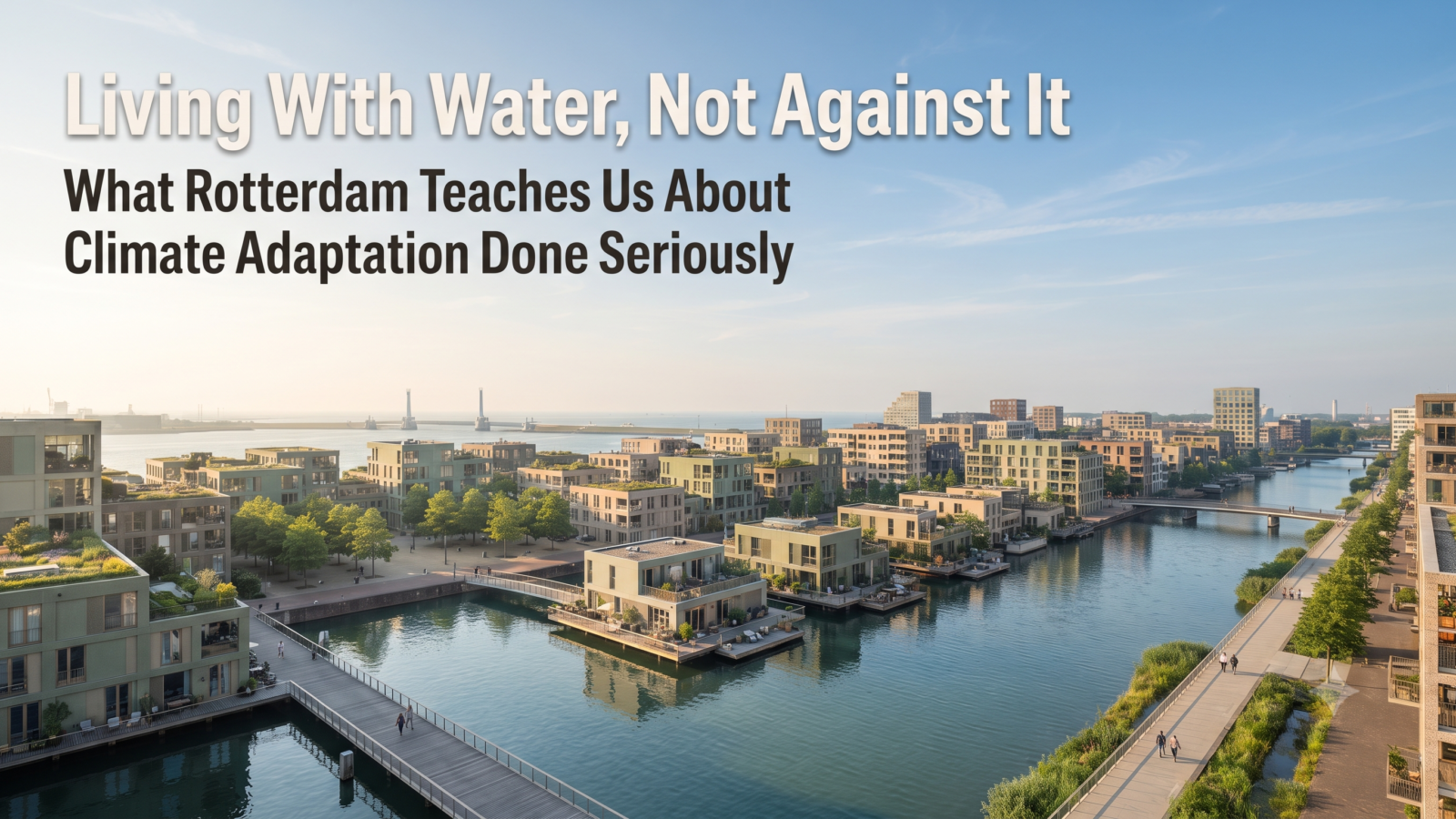
Water squares and public plazas set lower than the surrounding street, designed to fill with rainwater during heavy storms and function as amenities the rest of the time. Underground water storage below car parks. Over one hundred hectares of green roofs, subsidised by the municipality. Rooftop parks that double as flood defences. Water-robust streets and bioswales that let rainfall infiltrate rather than run off. Floating buildings and floating neighbourhoods in areas the city has designated as outer-dyke, deliberately outside the traditional defence line, and designed to rise and fall with the water.
Framed differently: Rotterdam has treated climate adaptation as an urban design problem, not only an engineering one. Every public space is a candidate for water storage. Every roof is a candidate for absorption. Every neighbourhood is a candidate for either dry protection or wet adaptation. The city has been transparently divided into an inner-dyke area, protected by traditional defences, and an outer-dyke area, adapted to live with periodic flooding rather than resist it.
The most recent iteration of this strategy is the Rotterdam Weather-Wise Plan (2019) and its 2030 framework which extends the approach further into private property and community action, recognising that the municipality alone cannot deliver enough water storage without residents, businesses, and property owners contributing to it.
Why this approach endures
Many climate adaptation programmes lose momentum within a single political cycle. Rotterdam’s has now spanned more than fifteen years and four generations of water plans. Understanding why matters more than cataloguing the interventions.
- The first reason is that the strategy is legible in daily life. Water squares are places people gather, walk through, and use in dry weather. Green roofs are visible from the street. Floating neighbourhoods are photographed and shared. Adaptation that hides inside engineering drawings is easy to defund; adaptation that improves the everyday experience of a city people becomes politically difficult to reverse.
- The second reason is that responsibility is distributed. Rotterdam does not treat resilience as something the city government delivers to residents. It treats it as a shared programme in which municipal defences, private property owners, businesses, and community-level interventions all contribute. That distribution builds constituencies who have a huge contribution in the strategy.
- The third reason is that the strategy is honest about its geography. Rotterdam does not pretend the whole city can be equally protected. Its inner-dyke and outer-dyke framing is a public acknowledgement that different parts of the city face different levels of risk and require different responses. That honesty is uncomfortable, but it is more durable than pretending otherwise.
What this means for anyone facing similar challenges
Rotterdam is not a template that will transplant cleanly to Lagos, Ho Chi Minh City, New Orleans, or the Thames Estuary. Its resources, governance, geography, and political stability are specific to it. But the underlying discipline of its approach is transferable, and I would offer three reflections for anyone working on climate adaptation elsewhere.
- First, decide whether your city is fighting water or should live with it and design accordingly. The most confused adaptation programmes I have observed are the ones that behave as if they are fighting water while producing communications that promise coexistence. Rotterdam’s clarity of intent is what makes the strategy coherent. Choose the frame consciously.
- Second, treat adaptation as an urban and social design problem, not only an engineering one. Rotterdam’s most-quoted innovations including water squares, green roofs, floating neighbourhoods work because they are simultaneously flood-management infrastructure and desirable places to live, work, and gather. Resilience measures that only function during disasters rarely get maintained. Resilience measures that improve daily life are far more likely to endure, be funded, and be replicated.
- Third, be honest about who is inside the defence line and who is outside it. Rotterdam’s inner-dyke/outer-dyke framing is not a marketing choice. It is a public acknowledgement that adaptation has geographical asymmetries, and that those asymmetries deserve to be named and planned around rather than obscured. Communities that pretend all residents are equally protected tend to be the communities where crisis eventually falls hardest on the people who were quietly outside the line all along.
A closing reflection
Rotterdam matters, in the end, because it is a working example of what serious climate adaptation looks like when it is pursued for two decades rather than one budget cycle. It is not a showpiece. It is a systemic connection of barriers and basins, roofs and squares, private and public action, all pulling in the same direction with a clear enough philosophy behind them that the parts add up.
That is the standard the rest of us should be measuring our own adaptation programmes against. Not the specific interventions, which are place-specific and unavoidably so. But the underlying discipline: honest framing, sustained multi-decade commitment, resilience woven into daily life, and open reckoning with geographical asymmetries.
The water is coming. Rotterdam is one of the few great cities that has taken the last twenty years to prepare seriously for it. And the question I would leave with anyone reading this from a flood-exposed community is a simple one: when your equivalent of the water comes, what will you have spent the last twenty years doing?
I’d be interested to hear from those working on climate adaptation in cities and regions: where are you seeing the shift from fighting water to living with it and where is that shift still being resisted today?