A city sinking faster than it can be defended
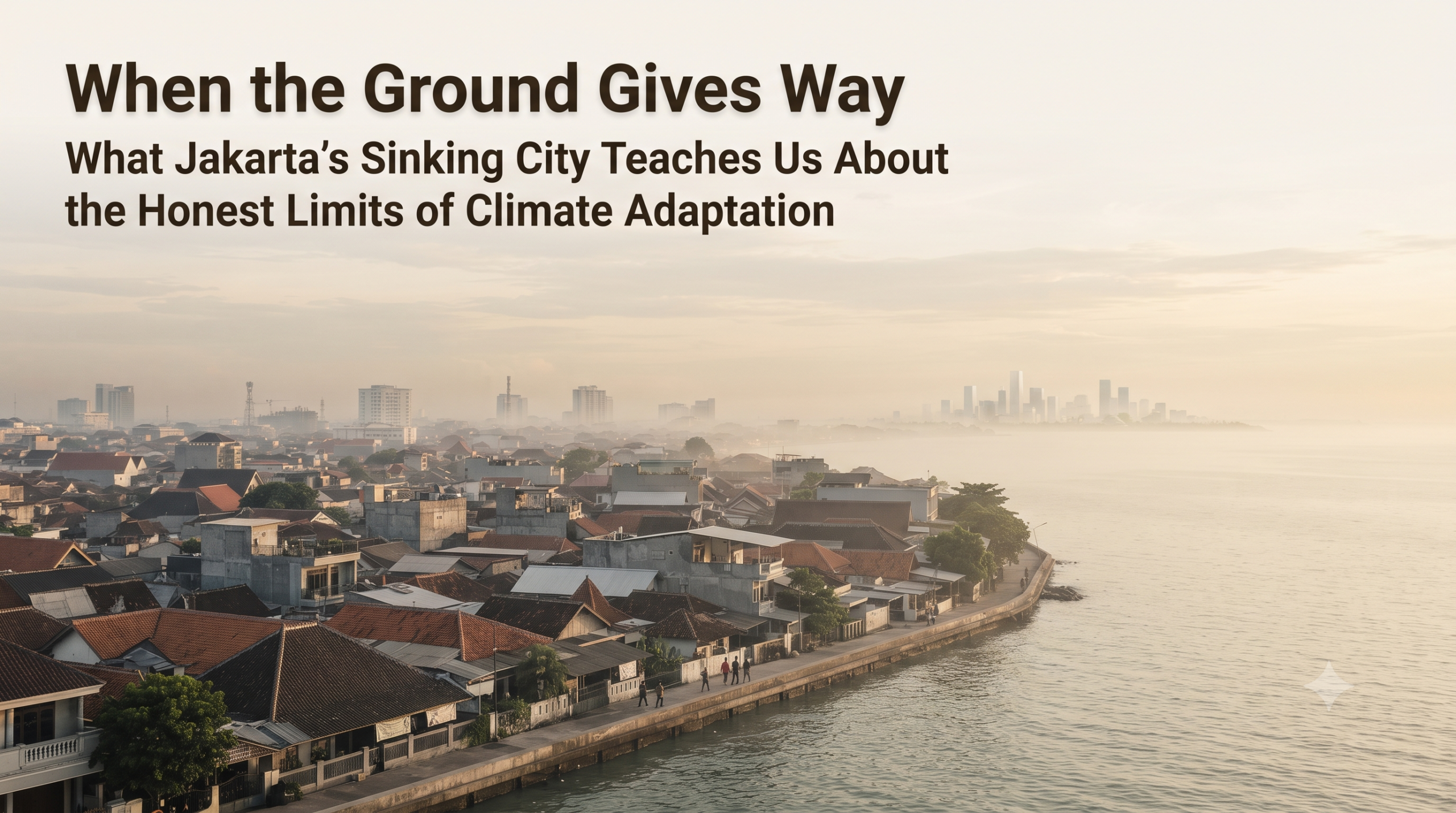
Jakarta is not sinking metaphorically. It is sinking physically, at a rate that has become one of the most-studied cases of urban subsidence in the world. Parts of North Jakarta have dropped by more than two and a half metres over the past decade, with some neighbourhoods still falling at ten to twenty-five centimetres a year. Around forty percent of the city already sits below sea level. Scientists project that up to a quarter of Jakarta could be underwater by 2050.
The causes are a combination of climate change and a specifically local failure. Yes, the Java Sea is rising. But Jakarta’s subsidence is driven overwhelmingly by decades of unregulated groundwater extraction where millions of residents drawing water from beneath the city because a reliable piped supply was never fully built. As the aquifers empty, the ground collapses onto itself. Add rapid urbanisation, poor drainage, and an increasingly volatile monsoon, and you have a city whose ground is falling faster than any engineered defence can be raised.
This last point is critical, and it is where the standard climate resilience solution fails. A seawall, however tall, cannot outpace a subsidence rate of twenty-five centimetres a year. The engineered defence is in itself sinking. Even Indonesia’s earth scientists have said, plainly, that seawalls in Jakarta are a delaying measure, not a solution.
The decision to move
Faced with that reality, Indonesia has made an unusually honest decision. Rather than promise a technical solution the physics obviously does not support, the government has begun relocating the national capital function to Nusantara, a purpose-built city being constructed in East Kalimantan on the island of Borneo, roughly two thousand kilometres away.
The project was inaugurated in August 2024, is estimated to cost in excess of thirty billion dollars, and is planned to be completed in phases through to 2045. Nusantara is being designed with climate resilience embedded from the start; with renewable energy, low-carbon construction, integrated public transport, protected green space, and a stated target of carbon neutrality.
Jakarta itself is not being abandoned. Around ten million people still live there, and the Indonesian government continues to invest in coastal defences, including a large-scale seawall programme along Java’s northern coast. But the strategic recognition that some places will not be saveable in their current form is exactly the kind of honesty most climate-exposed governments are still avoiding.
That honesty is, in my view, the single most important thing to notice about the Jakarta case. Not the cost of Nusantara. Not the engineering of the new city. But the willingness of a government to look at its capital and say publicly that the physics is no longer negotiable.
What are the social consequences of this retreat?
The Jakarta case also carries a difficult lesson about who a strategic retreat serves, and who it does not. The relocation of the capital is, in practice, a relocation of government function and future investment. Most of Jakarta’s residents, particularly the urban poor, will remain in the sinking city. Nusantara is planned for around 1.5 million people at maturity which represents a small fraction of Jakarta’s population. This means the resilience benefit of the retreat is, at least in the near term, concentrated in the parts of the population most able to move.
Nusantara’s construction has also raised legitimate environmental justice concerns about the displacement of Indigenous communities in East Kalimantan, and about the ecological impact of building a large new city in a biodiverse rainforest region. A retreat that solves one climate justice problem while creating another is not a clean solution.
I raise these points not to argue against the decision. On the physical evidence, the decision looks sound. I raise them because any organisation, city, or country contemplating retreat as a climate resilience strategy needs to plan for both ends of the move, yes, the place people are leaving, and the place people are going to. Retreat is a valid response to climate risk but it is definitely not a costless one.
What this means for anyone facing similar decisions
Jakarta is an extreme case. Most cities will not need to relocate a capital function. But the underlying question Jakarta has been forced to confront is at what point does adaptation stop being possible? is one that a growing number of coastal, delta, and low-lying communities will need to answer very critically.
Here are three reflections from the Jakarta case which are worth carrying into any resilience conversation.
- First, be honest about the physical limits of your adaptation strategy. Some climate risks can be engineered against. Others cannot be engineered against fast enough, or cheaply enough, or reliably enough. The most dangerous position for any community is to commit publicly to an adaptation plan that it quietly cannot deliver because it defers the harder decision until crisis conditions force it. Jakarta’s honesty about subsidence, however delayed, is more useful than a decade more of politically comfortable seawall announcements.
- Secondly, distinguish between defensive investment and strategic direction. Indonesia is still investing in Jakarta’s flood defences. That is defensive investment, buying time, protecting people who remain, and mitigating damage. Nusantara is the strategic direction where future national investment is going. Communities facing serious climate risk often need both, and often confuse them. Naming which is which is part of the discipline.
- Thirdly, plan for those left behind as well. If retreat is part of your resilience strategy, the question is not only where are we going? but who is not coming with us? Any credible relocation programme has to name that asymmetry openly and design against it well enough through continued investment in the origin location, through inclusive resettlement policies, and through engagement with the communities affected by the destination as well.
Closing reflection
Jakarta is not a template. No two cities face identical geography, politics, or resources. But Jakarta’s willingness to say publicly what most climate-exposed cities are still avoiding which is that some grounds are giving way faster than any defence can be raised, for me is a form of leadership our profession does not yet know how to celebrate properly.
What are your thoughts??? Share in the comments.