There is a conversation I have had, in various forms, with almost everyone I know who works seriously on climate. It rarely happens in meeting rooms. It happens quietly, at the edge of an event, over a coffee, or in a message late at night. It goes something like this: some days, I don’t know how to keep doing this. I have said it. I have heard it said. And for a long time, I did not have language for the specific weight behind it. It was not general stress. It was not ordinary work fatigue. It was something more particular to the nature of climate work which is the emotional cost of caring about a crisis whose scale and pace can, on some days, feel unbearable.
Recently, I attended an Emotional Resilience for Climate Workshop as part of my Terra.Do Climate Fellowship, facilitated by Nikyta Palmisani, an ecopsychology practitioner and climate educator. What struck me most about the workshop was not that it introduced new coping techniques, though it did, but that it gave language to feelings many of us in the climate space carry without naming. Honestly, that act of naming, as any psychologist will tell you, is itself the first step toward being able to respond to what we feel rather than be quietly overwhelmed by it.
I want to share some of what I took from that workshop, because I think this conversation belongs in a much wider circle than climate professionals alone. Anyone paying attention to what is happening in the world right now; the climate news, disaster updates, political inaction, extreme weather events and all is definitely carrying some version of these feelings, whether or not they have language for them.
The field that gave us the language
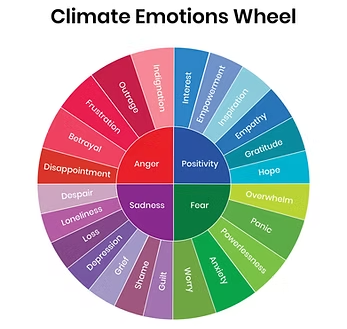
The workshop introduced me to the field of ecopsychology — a discipline that starts from a simple but radical premise: that individual mental health and wellbeing cannot be fully separated from the health of the ecosystems we live within. Traditional psychology treats the mind as something bounded by the skin. Ecopsychology treats the mind as something inextricably entangled with place, environment, and the more-than-human world. Out of this field has come a growing vocabulary of what researchers call psychoterratic emotions which are defined as earth-related mental health experiences. Many of the terms were coined by the philosopher Glenn Albrecht, with others developed by figures such as Joanna Macy, whose work on The Work That Reconnects has shaped several generations of climate educators.
The vocabulary matters because, as psychologist Dan Siegel puts it, “name it to tame it.” Labelling a feeling accurately activates the part of the brain responsible for reasoning and quiets the part responsible for emotional reactivity. It moves us from being reacted through by our emotions to responding with them.
The emotions worth knowing by name
Below are some of the psychoterratic emotions the workshop covered. I share them not as a diagnostic list, but as a vocabulary, because I suspect many readers will recognise several of these experiences in themselves the moment they see them named.
Eco-anxiety is the stress and worry specifically related to the ecological crisis. It is now well-documented among young people in particular. A large-scale study found that 84% of children and young people surveyed expressed at least moderate worry about climate change. Eco-anxiety is not a disorder. It is often an entirely rational response to accurate information about the state of the world.
Eco-grief is a response to ecological loss, the loss of physical environments, the anticipated losses of the future, the disruption of environmental knowledge systems and ways of life. It can carry all the classical features of grief: sadness, anger, bargaining, denial, and eventual acceptance. It is grief for places, species, and futures, not only for people.
Eco-guilt is the feeling of having personally contributed to the ecological crisis, or of having violated one’s own values in ways one cannot fully undo. It is common among climate professionals, people who are, ironically, often doing the most to address the crisis they feel guilty about.
Eco-anger sometimes called terrafurie, is anger directed at those perceived as responsible for ecological destruction, or at leaders and institutions who have failed to respond. What was interesting in the workshop was that eco-anger, unlike some other climate emotions, tends to be adaptive. It often mobilises people into action and is less associated with burnout than eco-anxiety or eco-grief. Anger, channelled well, can be fuel.
Eco-paralysis is the inability to meaningfully respond to the climate crisis, either because the emotional shock is too great, or because the cognitive load of navigating so many conflicting options for action produces overwhelm. Many people mistake eco-paralysis for apathy in themselves or others. It is usually the opposite, it is caring too much with no clear way to act.
Solastalgia, which is one of Albrecht’s most well-known terms, is the lived experience of watching a place you love be physically damaged or destroyed while you still live in it. It is not nostalgia, because home still exists; it is the pain of home being lost while you are still standing in it.
Eco-nostalgia is the closely related feeling of returning to a place after time away and finding it transformed — a coastline eroded, a forest cleared, a familiar landscape unrecognisable.
Disenfranchised grief is grief that others do not recognise or make space for. Much environmental grief is disenfranchised. We do not, as a culture, yet have rituals or public permission to mourn ecosystems, species, or places. And so those who feel these losses often carry them alone.
Alongside these harder emotions, the workshop also named the positive psychoterratic emotions, those ones that motivate and sustain us in the midst of the problem. Endemophilia is the deep, innate love for the unique features of one’s local environment. Eutierria is the feeling of total harmony with a place, often accompanied by a naïve, welcome loss of ego. These positive emotions matter not as afterthoughts but as the fuel of long-term climate action. As Palmisani put it, we start with what we love. This is why we do the work.
Practical ways to build emotional resilience
Language is the beginning of resilience, not the end of it. The workshop offered several practical directions that I have been thinking about since. I’ll share the ones that landed most for me.
First, community is not optional. The single most consistent finding across the ecopsychology literature is that the people who sustain climate engagement over decades are not the ones with the most willpower. They are the ones who are held in supportive community. Isolation is the fastest route to burnout. Being able to speak your climate feelings to people who understand them without needing to explain, justify, or perform is one of the most protective factors available to any climate-engaged person.
Second, action itself is part of coping. Eco-paralysis feeds on inaction, and inaction feeds eco-paralysis. Meaningful action however small interrupts the loop. It does not need to be world-changing action to be resilience-building action. What matters is that the action is meaningful to you and connected to others.
Third, self-care is not an indulgence; it is infrastructure. Time in nature, movement, journaling, meditation, creative practice, and rest are not luxuries in this work. They are what allows the work to be sustained. Activism has a rhythm. Constant action without restoration is a straight line to burnout and to leaving the movement altogether.
Fourth, learn to hold complexity without collapsing. Climate work asks us to hold contradictory truths simultaneously: the world is in crisis and meaningful progress is happening; individual action matters and is insufficient; the future is frightening and still worth working for. Resilience is partly the capacity to hold these together without demanding that they resolve.
Fifth, allow yourself distance. One of the most useful things Palmisani said in the workshop was a reminder to take time and distance from climate work when needed. This is not disengagement. It is what allows engagement to continue.
A note on those hostile to climate action
The workshop focused on our own emotional lives. But many of us also carry a quieter question: how do we engage with people who are actively hostile to climate action? Those who deny, the ideologically opposed, the far right voices increasingly loud in this space or even the political antagonism? I want to offer a few thoughts, drawn less from the workshop and more from my own reflection.
- The first is that not every hostile person is the same. There is a meaningful difference between someone who is confused, someone who is fearful, someone whose economic identity feels threatened by climate policy, and someone who is ideologically committed to opposition. The first three groups are often reachable through respectful, patient conversation. The fourth rarely is and expecting to change their mind through a single interaction is a recipe for exhaustion.
- The second is that our energy is finite. The mathematics of climate persuasion is such that the highest-leverage conversations we can have are almost never with the most hostile people. They are with the quietly uncertain, our neighbours, colleagues, and family members who have not yet formed a firm view and who trust us. Spending our limited emotional bandwidth on the most hostile voices while neglecting the persuadable is a common trap.
- The third is that hostility is often fear in disguise. When someone becomes aggressive about climate action, they are often responding to a felt threat most times to their identity, their community, their economic future, their sense of control. This does not excuse aggression, and it does not oblige us to absorb it. But it can, sometimes, change what we choose to say in response.
- And the fourth is that we do not have to engage with everything. There is a specific form of eco-anger that is legitimate, and there is another form that is simply the debris of hostile online exchanges being carried into our nervous systems. The first can fuel us. The second only depletes us. Learning to distinguish the two is part of the discipline.
A closing reflection
What has stayed with me most since the workshop is the simple fact of naming. That there are words like solastalgia, eco-grief, terrafurie, endemophilia, etc for what many of us feel but have not previously been able to articulate. That these feelings are not evidence of individual weakness but of intelligent, caring people responding honestly to accurate information about the world we live in and that they are not a crisis to hold alone.
It is very important to note that the climate crisis will not be solved by emotionally exhausted people acting in isolation. It will be met, if it is met, by communities of people who can name what they feel, hold each other through it, and keep going.
Whatever role you play in this work, be it as a professional, volunteer, worried citizen, quiet ally, I hope you know that your feelings are not a private failure. They are, in many ways, the most rational response to what is happening. And they deserve to be met with the same seriousness we give to any other part of our climate practice.
I’d be interested to hear from those working in or affected by the climate space: which of these emotions have you recognised in yourself, and where have you found the community that helps you hold them?