SUMMARY
Climate resilience is not a luxury — it is a survival strategy. For vulnerable communities across the developing world, building the capacity to withstand, adapt to, and recover from climate shocks is among the most urgent challenges of our time. This article examines what resilience really means, where it is most needed, and the frameworks making it possible.
Resilience, in the climate context, refers to the ability of communities, systems, and institutions to absorb the shocks of a changing climate while continuing to function and ultimately transform toward greater sustainability. It encompasses disaster preparedness, infrastructure investment, food system adaptation, and — crucially — the inclusion of communities themselves in designing their own futures.
The Scale of the Challenge
The UNEP Adaptation Gap Report 2024 delivers a stark message: nations must dramatically increase climate adaptation efforts. For many developing countries, disaster-related losses are already catastrophic. The IMF notes that in some cases, disaster-related economic losses have exceeded 200% of GDP — as was the case when Hurricane Maria struck Dominica in 2017. In South Sudan in March 2024, temperatures soared to 113 degrees Fahrenheit, prompting the government to declare a serious health hazard and send 2.2 million children home from school. In the Pacific, children in Fiji lost approximately two months of learning — 20% of a typical academic year — due to climate disruptions in an 18-month period.
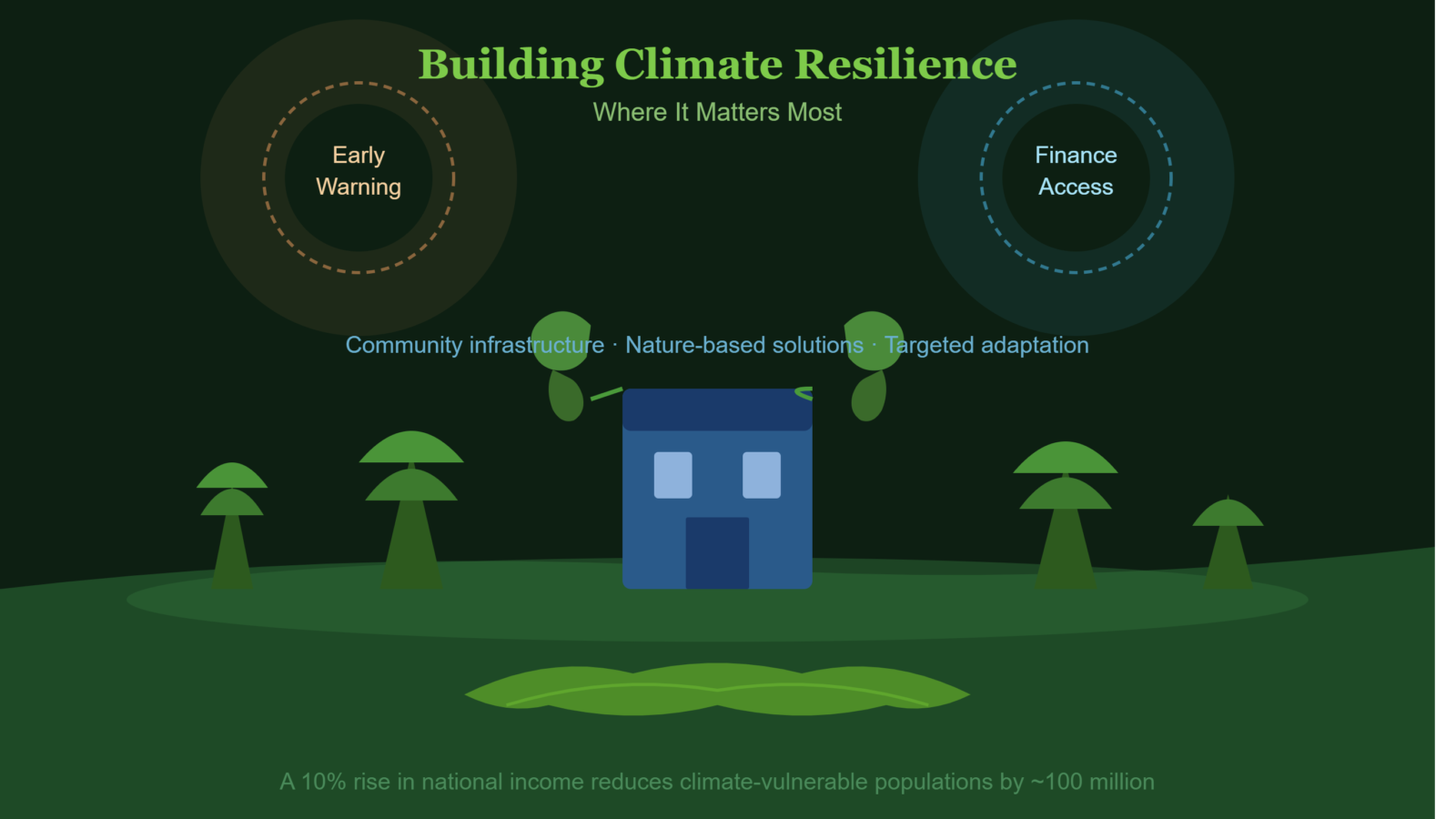
A World Bank assessment of 44 countries reveals that most are still lagging in implementing resilience interventions, particularly those related to macro-fiscal policy and the monitoring and evaluation of adaptation actions. Development — economic, social, and infrastructural — plays a foundational role. The data shows that a 10% increase in national income is associated with a reduction of close to 100 million in the population at high climate risk. Yet income growth alone is insufficient without deliberate investment in resilience strategies.
“Reducing vulnerability to climate impacts and building resilience requires three things: more rapid development, more resilient development, and targeted adaptation interventions.”
Three Pillars of Climate Resilience
The World Bank’s framework for climate resilience identifies three interconnected imperatives. First, more rapid development — without access to basic infrastructure, housing, healthcare, and education, communities cannot build the adaptive capacity needed to weather climate shocks. Second, more resilient development — new infrastructure must be climate-proofed from the outset, incorporating flood defences, heat-resistant design, and sustainable water management. Third, targeted adaptation interventions — community-specific actions such as early-warning systems, drought-resistant seed varieties, mangrove restoration, and insurance schemes that protect smallholder farmers.
Locally-Led Adaptation: The Evidence
A critical insight emerging from global resilience research is that solutions are almost always local. Communities that understand their own geography, cultural practices, seasonal patterns, and social structures are better placed than external actors to design effective responses. The UAE Framework for Global Climate Resilience, adopted at CMA 5 in December 2023 under the Paris Agreement, enshrines locally-led adaptation as a core principle — recognising that communities and local actors must have greater power and resources to build their own resilience.
In Bangladesh, one of the world’s most climate-vulnerable nations, government investment in cyclone shelters, early-warning systems, and community-level preparedness training has been repeatedly cited by the World Bank and UNDP as a model for disaster risk management. Since the 1970s, Bangladesh has dramatically reduced cyclone-related mortality despite facing increasingly powerful storms — demonstrating that systemic, government-backed resilience-building works.
In Guinea, the World Bank is supporting a Local Governance Support Project that mainstreams climate adaptation into local development plans, increasing the share of adaptation-focused financing at the community level. In Kenya, agroforestry initiatives are creating local jobs around protected areas while simultaneously restoring ecosystems and improving community food security.
“The solutions are always very local. It is important that people choose what solution works for them — we need to give communities the power and resources to lead their own resilience.”
Nature-Based Solutions
Ecosystems themselves offer some of the most powerful and cost-effective resilience tools available. Mangrove forests buffer coastlines against storm surge and erosion. Restored wetlands absorb floodwaters. Diverse agroforestry systems are more resistant to drought and pest pressure than monocultures. The World Resources Institute’s climate resilience programme supports governments and communities in scaling up nature-based solutions, integrating them into national adaptation plans.
UNEP’s practical guide to climate-resilient buildings and communities demonstrates how built environments — particularly in developing countries where much construction is self-built — can be redesigned to reduce heat absorption, improve ventilation, manage stormwater, and withstand cyclone forces. These are not futuristic technologies: they are accessible, culturally adaptable, and evidence-backed.
The Finance Gap
Despite the existence of frameworks and solutions, the finance gap remains the most significant structural barrier to climate resilience. The UNEP Adaptation Gap Report 2024 estimates the annual gap at $187 to $359 billion. Carbon pricing revenues globally reached a record $104 billion in 2023, according to the World Bank’s State and Trends of Carbon Pricing report — yet even this historic milestone falls far short of what is needed. Bridging the gap will require not only scaled-up public finance but innovative instruments: climate bonds, debt-for-nature swaps, parametric insurance, and blended finance mechanisms that can mobilise private capital toward resilience goals.
Climate resilience is ultimately not a technical problem. It is a political and financial one. The communities most in need of support have the least access to the resources required to build it. Closing that gap — through finance, technology transfer, and genuine partnership — is among the defining obligations of the international climate community in the years ahead.
Key References
- UNEP — Adaptation Gap Report 2024
- World Bank — Rising to the Challenge: Climate Adaptation and Resilience
- World Bank — A Climate Year in Review 2024
- UNFCCC — Adaptation and Resilience Introduction
- UNFCCC — The Paris Agreement
- IMF — Climate Change: Resilience Building
- World Resources Institute — Climate Adaptation and Resilience
- UNEP — Practical Guide to Climate-Resilient Buildings and Communities
- World Bank COP29 Event — Rising to the Challenge (2024)
- ScienceDirect — Climate-resilient development in developing countries (2024)