
SUMMARY
Individual action on climate change can feel insignificant in the face of a global crisis. But local action — multiplied across millions of people and communities — is one of the most powerful forces for change. This article offers five concrete, evidence-backed actions you can take starting today.It is a question almost everyone has asked at some point: “What can I actually do about climate change?” The honest answer has two parts. First, systemic change — policy, infrastructure, finance — is essential and only governments and large institutions can deliver it at scale. Second, individual and community action genuinely matters: it reduces emissions directly, builds political will, shapes markets, and creates the cultural shift without which no policy succeeds. Here are five actions grounded in the evidence.
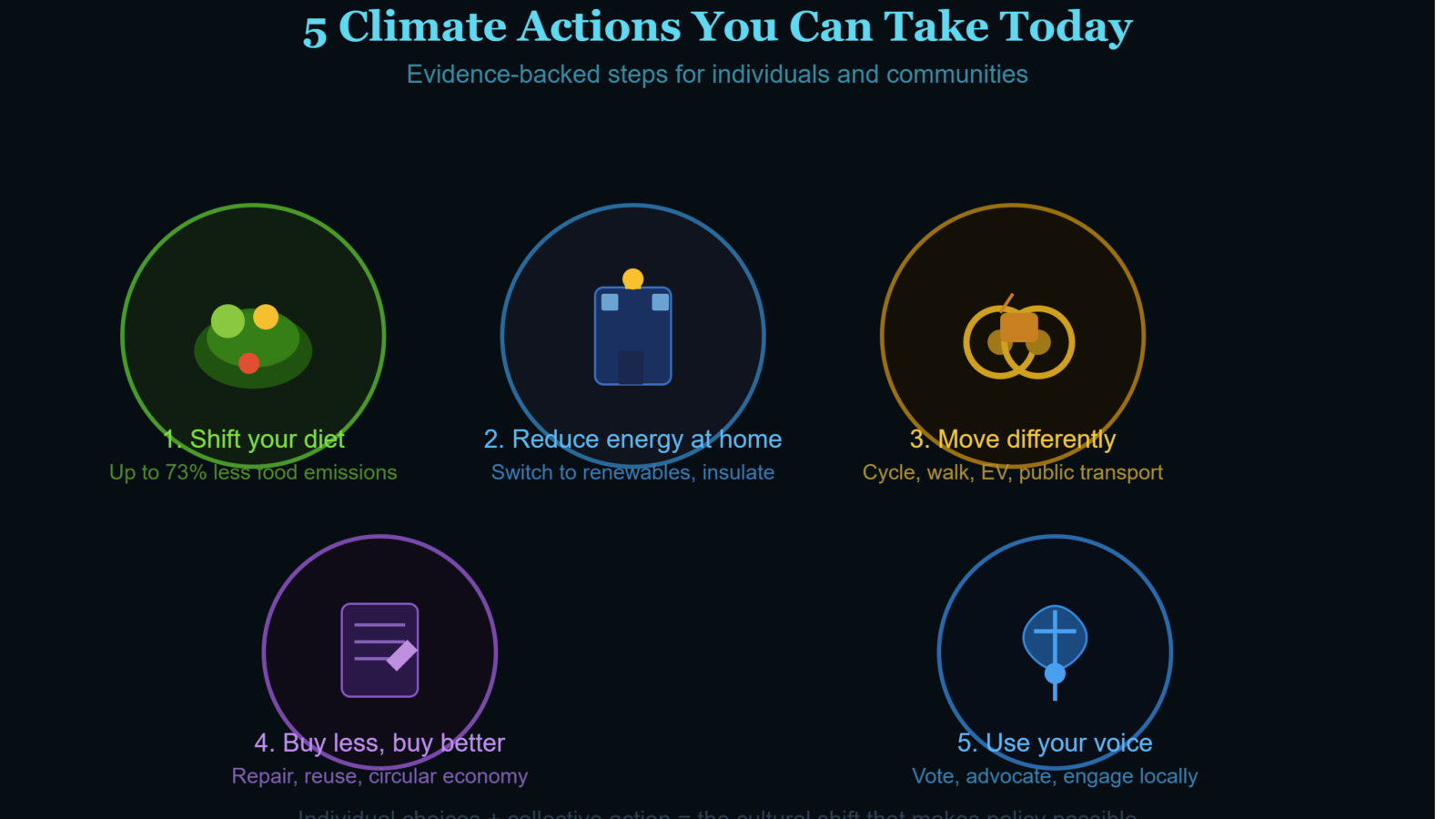
1. Shift What You Eat — Especially Protein
Food systems account for between 21% and 37% of global greenhouse gas emissions according to the IPCC. Of this, animal agriculture — particularly beef and dairy — is the largest contributor. The global average carbon footprint per person sits at approximately 4.7 metric tonnes of CO2 per year (Global Carbon Project, 2024). Shifting to a plant-rich diet — not necessarily entirely plant-based, but substantially reduced in red meat — is among the single highest-impact individual actions available. Research published by Oxford University’s Joseph Poore and colleagues found that moving to a plant-based diet could reduce an individual’s food-related emissions by up to 73%.
You do not need to go vegan overnight. Start with one or two meat-free days per week, explore local plant-based proteins, and support restaurants and supermarkets that offer sustainable choices. Buying local, seasonal produce reduces transport emissions and supports your local food economy simultaneously.
“Our food choices are among the most powerful — and most immediate — levers available to individuals. What ends up on your plate has consequences that ripple across the food system and the climate.”
2. Reduce Energy Use at Home
Buildings are responsible for approximately 40% of global energy consumption and around 33% of energy-related CO2 emissions (IEA, 2024). Heating and cooling account for the largest share. At home, simple measures — draught-proofing, loft insulation, switching to LED lighting, and lowering thermostat settings by just one or two degrees — can meaningfully reduce both your emissions and your energy bills. If your energy provider offers a green tariff sourced from renewable energy, switching is one of the most impactful choices you can make in an afternoon.
If you are in a position to invest longer-term, heat pumps — which use electricity to transfer heat rather than burn fuel — are rapidly becoming the gold standard for domestic heating in temperate climates. The International Energy Agency notes that heat pump sales doubled globally between 2020 and 2023.
3. Move Differently
Transportation is the second-largest source of global greenhouse gas emissions after energy production, with personal vehicle use — particularly in high-income countries — accounting for a substantial share. Walking and cycling for short journeys eliminate transport emissions entirely while improving personal health. Using public transport in place of a private car typically reduces your per-journey emissions by 70-80%. Where car ownership is necessary, electric vehicles (EVs) offer significantly lower lifetime emissions, even when charged from a partially fossil-fuelled grid — and as grids decarbonise, those benefits compound.
Locally, advocating for better cycling infrastructure, bus routes, and pedestrian spaces is climate action too. Your voice as a resident — in planning consultations, local elections, and community forums — shapes the transport choices available to your whole neighbourhood.
4. Buy Less, Buy Better, Fix More
The carbon footprint of consumption — the goods we buy, the clothes we wear, the electronics we replace — is embedded in global supply chains that account for a significant portion of Scope 3 emissions worldwide. The most effective action is to consume less overall: buying durable goods, extending the life of electronics and clothing through repair, and choosing second-hand where possible. When purchasing is necessary, seeking out products with credible environmental certifications (Fairtrade, B Corp, Forest Stewardship Council) supports companies with lower-impact supply chains.
Local repair cafes, tool libraries, clothes swaps, and community markets are sprouting in neighbourhoods across the world — creating circular economy hubs that reduce consumption, build community, and keep resources in use. Finding and supporting these in your area is both a climate action and an investment in local resilience.
5. Use Your Voice — Locally and Politically
Research by Dr. Kimberly Nicholas and colleagues found that the highest-impact individual climate action, after having one fewer child, is talking about climate change — normalising it, demanding action from institutions, and using democratic participation to shape policy. This means voting in local and national elections with climate policy as a priority consideration, attending public consultations on planning and transport decisions, and engaging with your employer, local council, school, or place of worship on their climate commitments.
It also means supporting and connecting with local climate groups — whether that is a community garden, an energy cooperative, a Transition Towns initiative, or a national campaign. Collective action amplifies individual effort and creates the social proof that encourages others to act. In the words of the UNDP Human Development Report: “Individual choices and collective actions are not alternatives — they are complements.”
“The most powerful thing any individual can do for the climate is to stop thinking of themselves as merely an individual. You are a citizen, a consumer, a voter, a community member — and each of those roles is a lever for change.”
Key References
- Global Carbon Project — Global Carbon Budget 2024
- Poore & Nemecek — Reducing food’s environmental impacts (Science, 2018)
- IEA — Buildings: Energy Technology Perspectives
- IPCC — AR6 WGIII: Mitigation of Climate Change (2022)
- Project Drawdown — Table of Solutions
- UNDP — Human Development Report 2024
- Climate Outreach — Talking Climate Communication Guide
- Transition Towns Network
Climate education system
Climate education