SUMMARY
Climate education is undergoing a profound transformation. Moving beyond textbooks and lectures, the future of climate learning is participatory, digital, locally rooted, and action-oriented. This article examines the trends, innovations, and structural shifts shaping what it means to learn about — and for — the climate crisis.
For most of the twentieth century, environmental and climate education occupied a narrow space: a chapter in a geography textbook, a school trip to a nature reserve, perhaps a module in a university science course. That model is no longer adequate for the scale and urgency of the challenge we face. The future of climate education is being written by communities, innovators, and young people who understand that what is needed is not just knowledge — but the capacity, confidence, and connection to act on that knowledge.
From Information to Transformation
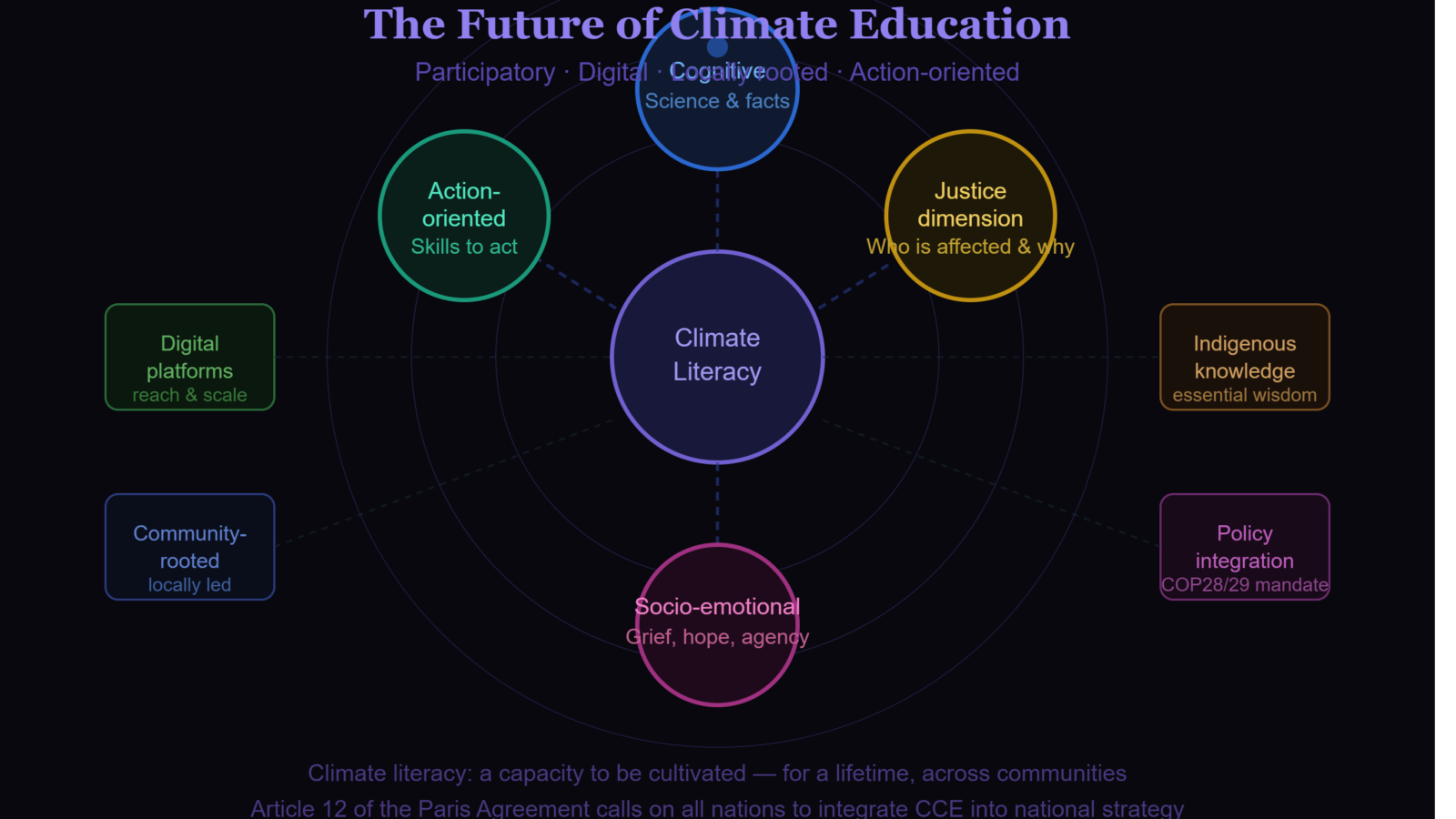
The shift in climate education thinking is captured well in the framework proposed by Stevenson and Peterson (2016) and echoed by UNESCO, the IPCC, and multiple national education authorities: quality climate change education (CCE) must address four interlocking dimensions. The cognitive dimension — understanding the science and the facts — is only the first. Equally important are the socio-emotional dimension (processing climate grief, anxiety, and hope), the action-oriented dimension (developing the skills to act effectively), and the justice dimension (understanding who is affected and why inequity is central to the crisis).
This four-part framework is generating a wave of pedagogical innovation. Schools adopting project-based learning for climate have students designing community energy audits, running local biodiversity surveys, and developing adaptation proposals for their neighbourhoods. Universities are embedding climate thinking across disciplines — in law, economics, public health, architecture, and business, not just in natural sciences. Vocational training programmes are integrating green skills into construction, agriculture, and engineering curricula.
“Climate education must not only inform — it must transform. It must equip learners not just to understand the crisis but to navigate it, influence it, and survive it with their communities intact.”
Digital Platforms and the Democratisation of Learning
Digital technology is rapidly extending the reach of climate education to populations that formal institutions cannot serve. In Kenya, UNDP collaborated with UNICEF and the Ministry of Environment in 2024 to deliver climate finance workshops for young people across 26 counties, using a train-the-trainer model that created cohorts of peer educators — dramatically multiplying the reach of each expert facilitator. In Zimbabwe, an online learning platform is being developed to support self-paced climate finance education and mentoring for young project developers. In Morocco, a hackathon in January 2025 brought together 100 participants to develop innovative climate solutions — with UNDP and the Unleash community connecting Moroccan youth to a global network of climate innovators.
Social media has become one of the most powerful platforms for climate learning and mobilisation, particularly among young people. Climate communicators are reaching millions through short-form video, interactive infographics, and storytelling formats that traditional educational institutions cannot match for speed, accessibility, or cultural resonance. The challenge is ensuring that this democratised knowledge landscape is accurate, nuanced, and action-oriented — rather than driving anxiety without agency.
Indigenous Knowledge as a Climate Curriculum
One of the most exciting developments in climate education is the growing recognition of indigenous and traditional knowledge systems as essential — not supplementary — components of climate understanding. Indigenous communities across Africa, the Pacific, Latin America, and Asia possess generations of practical knowledge about ecosystem dynamics, seasonal patterns, land management, and community governance that Western science is only beginning to engage with as climate data sources.
Article 6 of the UNFCCC and Article 12 of the Paris Agreement call on countries to integrate climate change education into their national strategies. Progressive national governments are responding by developing culturally contextualised curricula that draw on local ecological knowledge, taught in local languages, and applied to local climate challenges. This approach not only improves educational outcomes but strengthens community ownership of climate adaptation strategies.
Systemic Integration: Education as Climate Policy
Perhaps the most significant trend in the future of climate education is its increasing recognition as a core component of climate policy — not an afterthought. UNICEF’s 2025 Strategy for Climate-Resilient Education Systems in Eastern and Southern Africa calls for climate-responsive teaching, safer and greener school infrastructure, and strengthened early warning systems that protect learning continuity during climate events. The strategy positions education systems not merely as delivery mechanisms for climate knowledge but as climate institutions in their own right — systems that must themselves be adapted to a changing climate.
At COP28 and COP29, education featured more prominently in formal negotiations than at any previous conference. Parties increasingly recognise that without a climate-literate global population, public support for the policy ambition needed to meet Paris Agreement goals will be difficult to sustain. The International Court of Justice’s 2024 advisory opinion clarifying that states have binding legal duties to address climate change — including through education and capacity-building — adds further legal weight to the case for systemic investment in climate learning.
“The battle against climate change will ultimately be won or lost in classrooms, community centres, online platforms, and kitchens — wherever people learn, discuss, and decide how to live in relationship with the planet.”
Building a Climate-Literate Generation
The future of climate education converges on a powerful insight: that climate literacy is not a subject to be taught and tested, but a capacity to be cultivated — for a lifetime, across communities, through experience as much as instruction. The most effective programmes share common features: they are grounded in the local and specific rather than the abstract and global; they connect knowledge to action; they take the emotional dimensions of climate learning seriously; and they treat learners as agents rather than audiences.
Building this capacity, at global scale, within the time frame that the climate crisis demands, is one of the greatest educational challenges in human history. It is also one of the greatest opportunities — to design learning systems worthy of the complexity, urgency, and possibility of the moment we inhabit.
Key References
- UNESCO — Global Education Monitoring Report 2023
- UNICEF — Strategy for Climate-Resilient Education Systems in Eastern and Southern Africa (2025)
- Brookings — Adolescents and Youth: Reimagining Climate Education in Eastern and Southern Africa (2026)
- UNDP Climate Promise — How Young People Are Building Skills for Climate Action (2025)
- MDPI Sustainability — Climate Change Education: Preparing African Youth (2025)
- UNFCCC — Paris Agreement Article 12: Education, Training and Public Awareness
- Springer Nature — Climate Change Education in African Higher Education Institutions
- International Court of Justice — Advisory Opinion on Climate Change Obligations (2024)
- IPCC — AR6 WGIII: Demand, Services and Social Aspects of Mitigation