SUMMARY
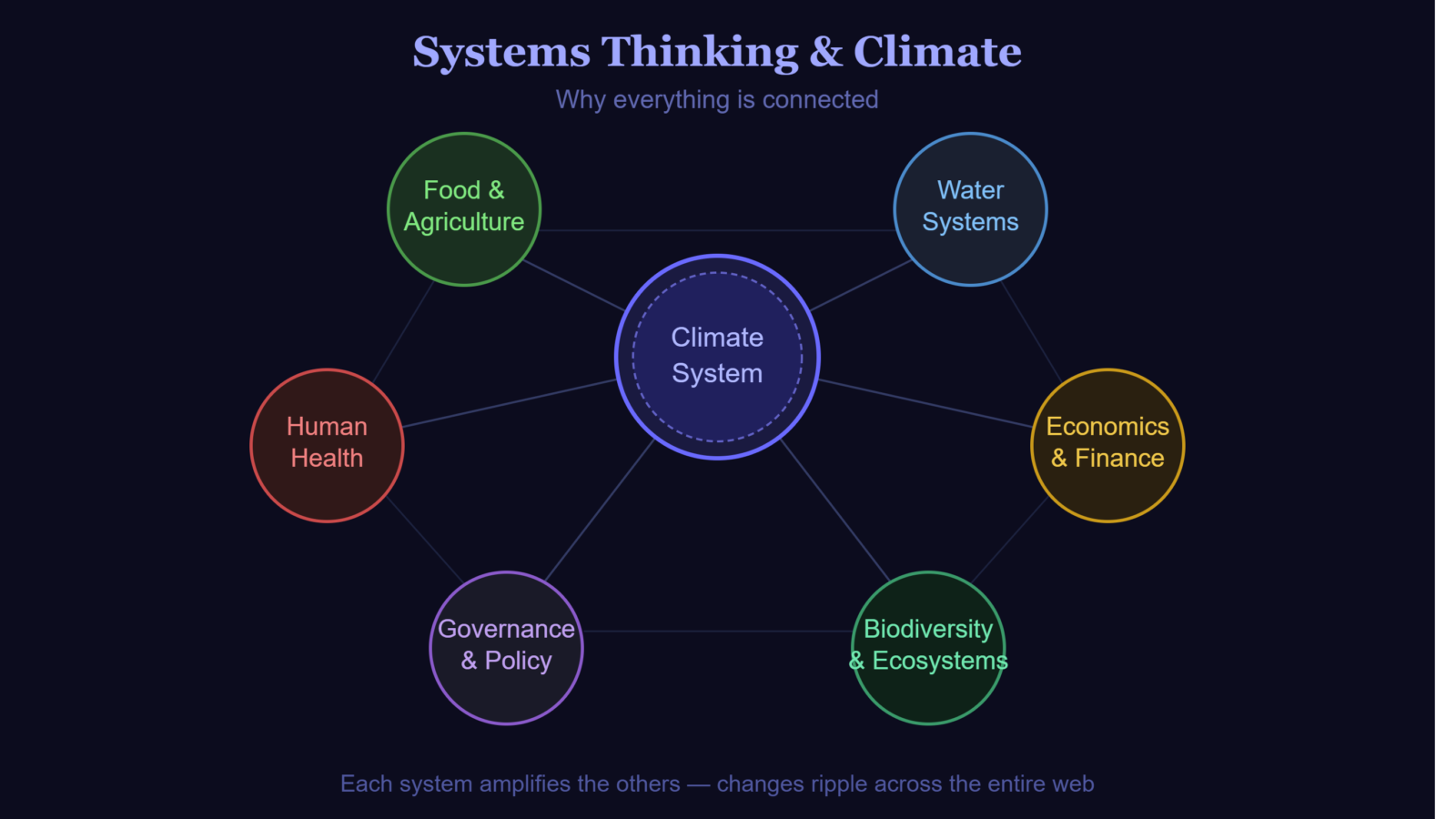
Climate change is not a single problem — it is a web of interconnected systems. From food and water to health, economics, and governance, the climate crisis cuts across every dimension of human life. Systems thinking offers a framework for understanding these connections and designing responses that work with complexity rather than against it.
To understand climate change fully, one must resist the temptation to treat it as a discrete, bounded problem. A drought in the Horn of Africa is not just an agricultural issue. It triggers food insecurity, displacement, competition over resources, public health crises, and political instability. A heatwave in South Asia reduces labour productivity, strains power grids, increases mortality, and reshapes migration patterns. Each event is a node in a vast, interconnected system — and addressing any single thread without understanding its connections to the whole is likely to be at best ineffective, at worst counterproductive.
What Is Systems Thinking?
Systems thinking is an analytical approach that looks at how a system’s constituent parts interrelate and how systems work over time and within larger systems. In the context of climate change, it means understanding that the atmosphere, oceans, ecosystems, human societies, and economies are deeply interdependent — and that changes in one domain ripple through all others in ways that are often non-linear, delayed, and difficult to predict.
The IPCC’s Sixth Assessment Report (AR6, 2022) represents one of the most comprehensive applications of systems thinking to the climate crisis to date. It examines the cascading risks that arise when climate impacts interact with social vulnerabilities, ecosystem degradation, and economic inequality — findings that cannot emerge from siloed, sector-by-sector analysis.
“We cannot separate the need for development from the need for resilience. It is all one integrated development path — and we have to understand the whole system to navigate it.”
The Climate-Food-Water-Health Nexus
Perhaps the most consequential set of interconnections is what researchers call the food-water-energy nexus — the recognition that food production, freshwater availability, and energy systems are mutually dependent and all profoundly affected by a changing climate. Higher temperatures reduce crop yields. Changing rainfall patterns alter river flows that feed irrigation systems. Melting glaciers threaten freshwater supplies for hundreds of millions of people in Asia and South America. And energy demands for cooling and water pumping rise as temperatures climb, creating feedback loops that strain already fragile infrastructure.
Public health systems are similarly embedded in this web. The Lancet Countdown on Health and Climate Change, published annually, tracks dozens of indicators linking climate shifts to disease burden. Rising temperatures expand the geographic range of mosquitoes, bringing malaria and dengue to populations with no prior exposure and no acquired immunity. Flooding events spread waterborne diseases. Extreme heat kills — particularly the elderly, outdoor workers, and those without access to cooling. A 2024 analysis found that human-caused climate change added 41 extra days of dangerous heat globally in 2024, directly impacting vulnerable populations and intensifying downstream health consequences.
Economic Feedback Loops
A 2025 study published in ScienceDirect, applying the Growth-at-Risk framework to 34 countries, demonstrated that asymmetric temperature shocks — particularly rare but severe events — have a significantly negative effect on GDP growth in vulnerable economies. The mechanism is systemic: agriculture, a major employer in climate-exposed regions, suffers reduced yields and income. Infrastructure is damaged. Labour productivity falls in construction and outdoor services. Public finances are strained by disaster response costs. Governance capacity weakens under compounded stress. Each of these effects amplifies the others — a classic feature of complex systems under stress.
The IMF has long recognised these feedback loops. Countries facing high climate exposure also tend to face elevated borrowing costs, constrained fiscal space, and reduced creditworthiness — precisely the factors that limit their ability to invest in the adaptation infrastructure they urgently need. Breaking these feedback loops requires systemic intervention: debt relief, concessional climate finance, and integrated economic planning.
“Climate change is not a single crisis in isolation. It is a threat multiplier — intensifying every existing vulnerability and creating new ones we have yet to fully map.”
Biodiversity and the Climate System
One of the most important but underappreciated systemic connections is between climate change and biodiversity loss. Healthy ecosystems — rainforests, wetlands, coral reefs, grasslands — serve as natural carbon sinks, absorbing and storing carbon dioxide. Their destruction not only releases stored carbon but diminishes the planet’s capacity to buffer climate variability. The two crises are inseparable: addressing climate change without restoring biodiversity is like patching one side of a leaking vessel while ignoring the other.
Applying Systems Thinking to Solutions
Systems thinking does not just illuminate problems — it transforms how we design solutions. In agriculture, it suggests diversified polyculture farming over monoculture, integrating soil health, water retention, pest management, and food security into a single adaptive strategy. In urban planning, it argues for green infrastructure — parks, permeable surfaces, urban forests — that simultaneously reduces heat island effects, manages stormwater, improves air quality, and enhances mental wellbeing. In policy design, it favours co-benefits: actions like transitioning to clean energy that simultaneously reduce emissions, improve public health, and create economic opportunities.
Ultimately, systems thinking is a call for humility and integration. The climate crisis did not arrive from a single source and will not be solved by any single lever. It demands that scientists, policymakers, communities, and businesses engage with complexity — learning to see the connections, respect the feedback loops, and act with awareness of the whole.
Key References
- IPCC — Sixth Assessment Report AR6 WGII (2022)
- IPCC — AR6 WGIII: Mitigation of Climate Change (2022)
- The Lancet Countdown on Health and Climate Change
- World Weather Attribution — When Risks Become Reality (2024)
- ScienceDirect — Climate Growth at Risk in the Global South (2025)
- IMF — Climate Change and Economic Risk
- IPBES-IPCC — Scientific Outcome: Biodiversity and Climate Change (2021)
- Donella Meadows Institute — Thinking in Systems.