SUMMARY
For organisations in every sector, the climate crisis is no longer an externality — it is a core strategic concern. Whether you are a multinational corporation, an NGO, or a small business, beginning your climate journey is both possible and necessary. This article offers a practical, evidence-informed roadmap for getting started.
The pressure on organisations to engage meaningfully with climate change has never been greater — from investors demanding ESG transparency, to regulators requiring climate risk disclosure, to employees and customers expecting genuine commitment. But the starting point for many organisations is the same honest question: where do we begin?
The answer is: with understanding. Before any organisation can act, it must know its own impact, its exposure to climate-related risks, and the opportunities a low-carbon transition can bring.
Step 1: Measure Your Carbon Footprint
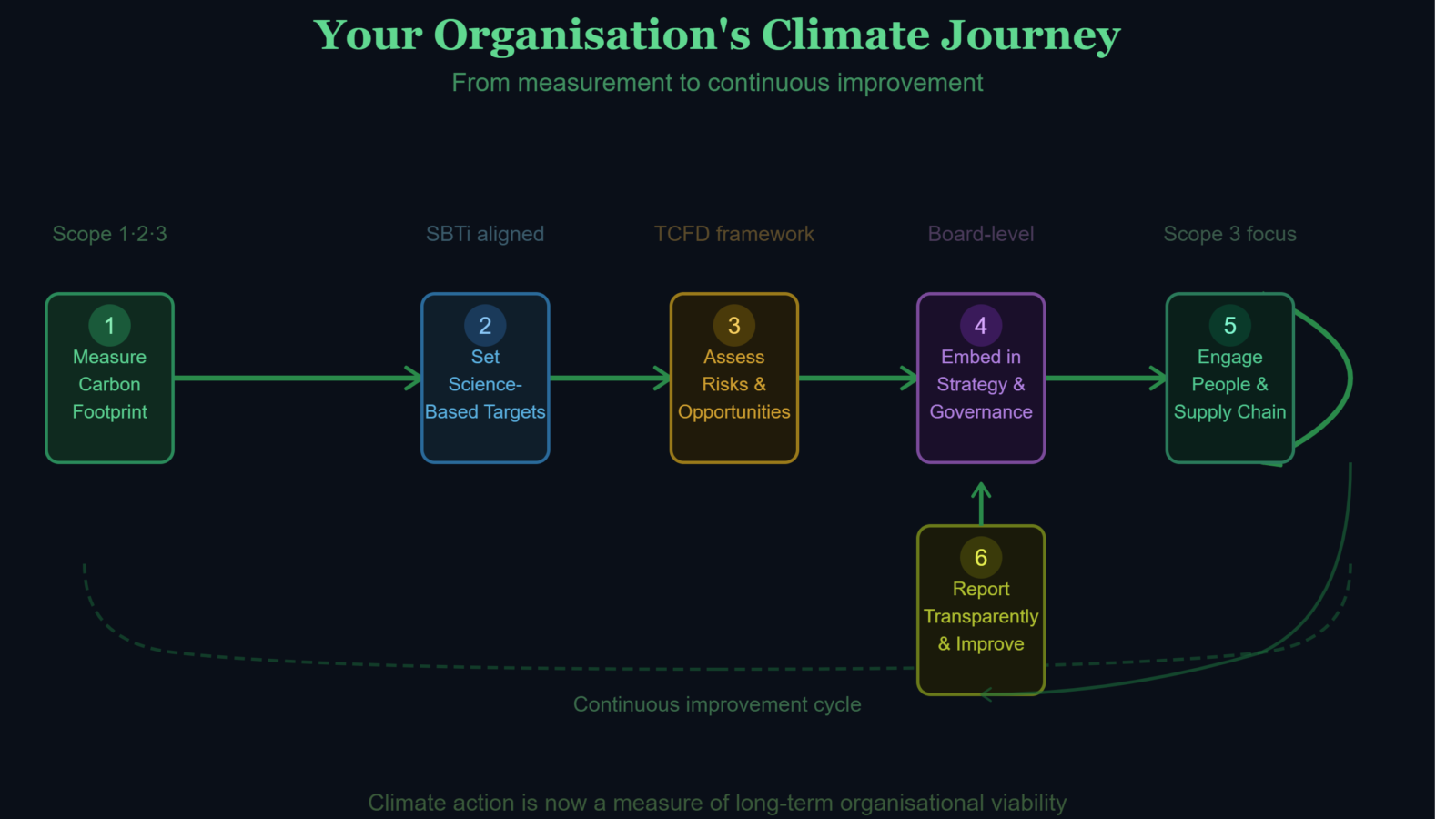
The foundation of any credible climate strategy is a clear-eyed assessment of your organisation’s greenhouse gas emissions. The internationally recognised framework for this is the GHG Protocol Corporate Standard, which categorises emissions across three scopes. Scope 1 covers direct emissions from owned facilities and company vehicles. Scope 2 covers indirect emissions from purchased energy. Scope 3 — the most complex and often largest category — covers emissions throughout the value chain: business travel, supply chains, product use, and waste.
Understanding your Scope 3 footprint is increasingly mandatory for large organisations. The Carbon Disclosure Project (CDP) and Task Force on Climate-related Financial Disclosures (TCFD) both emphasise that organisations unable to account for their full value-chain emissions cannot manage — or credibly report — their climate impact.
“You cannot manage what you cannot measure. A carbon footprint assessment is not just an accounting exercise — it is a map of your exposure, your risks, and your greatest opportunities for impact.”
Step 2: Set Targets Aligned with Science
Once an organisation understands its emissions baseline, the next step is to set meaningful reduction targets. The Science Based Targets initiative (SBTi) provides the most widely recognised framework, requiring companies to set emissions reduction targets in line with the level of decarbonisation needed to keep global temperature rise within 1.5°C. Targets approved by SBTi demonstrate to investors, customers, and regulators that your commitments are grounded in climate science rather than marketing.
For organisations in developing markets or smaller sectors, interim targets and pathway plans are equally important. What matters is not perfection but direction: a credible, time-bound trajectory toward net zero, with short-term milestones that can be monitored and reported.
Step 3: Assess Your Climate Risks and Opportunities
The IPCC AR6 WGII report identifies two categories of climate risk relevant to organisations. Physical risks are the direct impacts of climate change on operations — flooding disrupting manufacturing, heat damaging logistics, water stress affecting agricultural supply chains. Transition risks arise from the shift to a low-carbon economy — stranded assets in fossil fuel-dependent sectors, policy changes increasing carbon costs, shifting consumer preferences.
But alongside risks, the transition to a net-zero economy presents significant opportunities: demand for clean energy solutions, sustainable products, climate-resilient infrastructure, and green finance instruments is growing rapidly. Organisations that move early are positioned to capture these opportunities rather than scramble to manage risks retroactively.
Step 4: Embed Climate into Strategy and Governance
A climate strategy that lives only in a sustainability report has limited value. Embedding climate action into core business strategy, board-level governance, and executive performance frameworks is what transforms ambition into accountability. The TCFD framework recommends that boards actively oversee climate-related risks and that management integrate climate considerations into all major business decisions.
Internal carbon pricing — assigning a shadow price to carbon across business units — is one powerful mechanism for embedding climate into financial decision-making, incentivising investment in efficiency and renewables without waiting for external regulation.
“Climate action is no longer a reputational nice-to-have. It is fast becoming the most important measure of an organisation’s long-term viability and licence to operate.”
Step 5: Engage Your People and Supply Chain
An organisation’s climate journey is as much a cultural transformation as it is a technical one. Engaging employees at all levels — through climate literacy training, internal green champions, and participatory goal-setting — builds the internal capacity and ownership that sustains long-term commitment. Supply chain engagement is equally critical: for most organisations, Scope 3 emissions dwarf those under direct control, and supplier engagement programmes, procurement standards, and collaborative decarbonisation initiatives are essential tools.
Step 6: Report Transparently and Improve Continuously
Credibility in climate action is built through transparent, consistent reporting. The emergence of the International Sustainability Standards Board (ISSB) global disclosure standards, now adopted or referenced by regulators in over 20 jurisdictions, means that climate reporting is rapidly becoming mandatory rather than voluntary for large and listed organisations. Even for smaller organisations not yet subject to mandatory disclosure, establishing a reporting baseline early creates internal discipline and external trust.
Every organisation’s climate journey will look different, shaped by sector, geography, and capacity. What matters is that the journey begins — with honest measurement, credible targets, and genuine commitment to continuous improvement.
Key References
- GHG Protocol — Corporate Value Chain (Scope 3) Standard
- Science Based Targets initiative (SBTi)
- Task Force on Climate-related Financial Disclosures (TCFD)
- IPCC — AR6 WGII: Impacts, Adaptation and Vulnerability
- ISSB — IFRS S2 Climate-related Disclosures
- Carbon Disclosure Project (CDP)
- World Bank — State and Trends of Carbon Pricing 2024