SUMMARY
Climate change is the defining challenge of our era, yet many people still find the science difficult to access. This guide explains the basics in plain language: what climate change is, how it works, what is causing it, and what we can expect if the world does not act decisively.
The terms “climate change” and “global warming” are now part of everyday language. But what do they actually mean — and why do scientists describe this as one of the greatest challenges humanity has ever faced? This guide answers those questions in clear, accessible terms.
Climate vs. Weather: What’s the Difference?
Weather is what is happening in the atmosphere outside your window right now — the temperature this afternoon, whether it is raining today. Climate is the long-term pattern of weather across a region, measured over decades. When scientists talk about climate change, they are describing long-term shifts in global temperature and weather patterns, not just an unusually warm summer.
The distinction matters because the climate system operates on a different timescale from our daily experience. Small, gradual changes accumulate over years and decades into transformative shifts — in sea levels, storm intensity, rainfall patterns, and regional temperatures — that reshape entire ecosystems and human societies.
The Greenhouse Effect: The Science Behind the Crisis
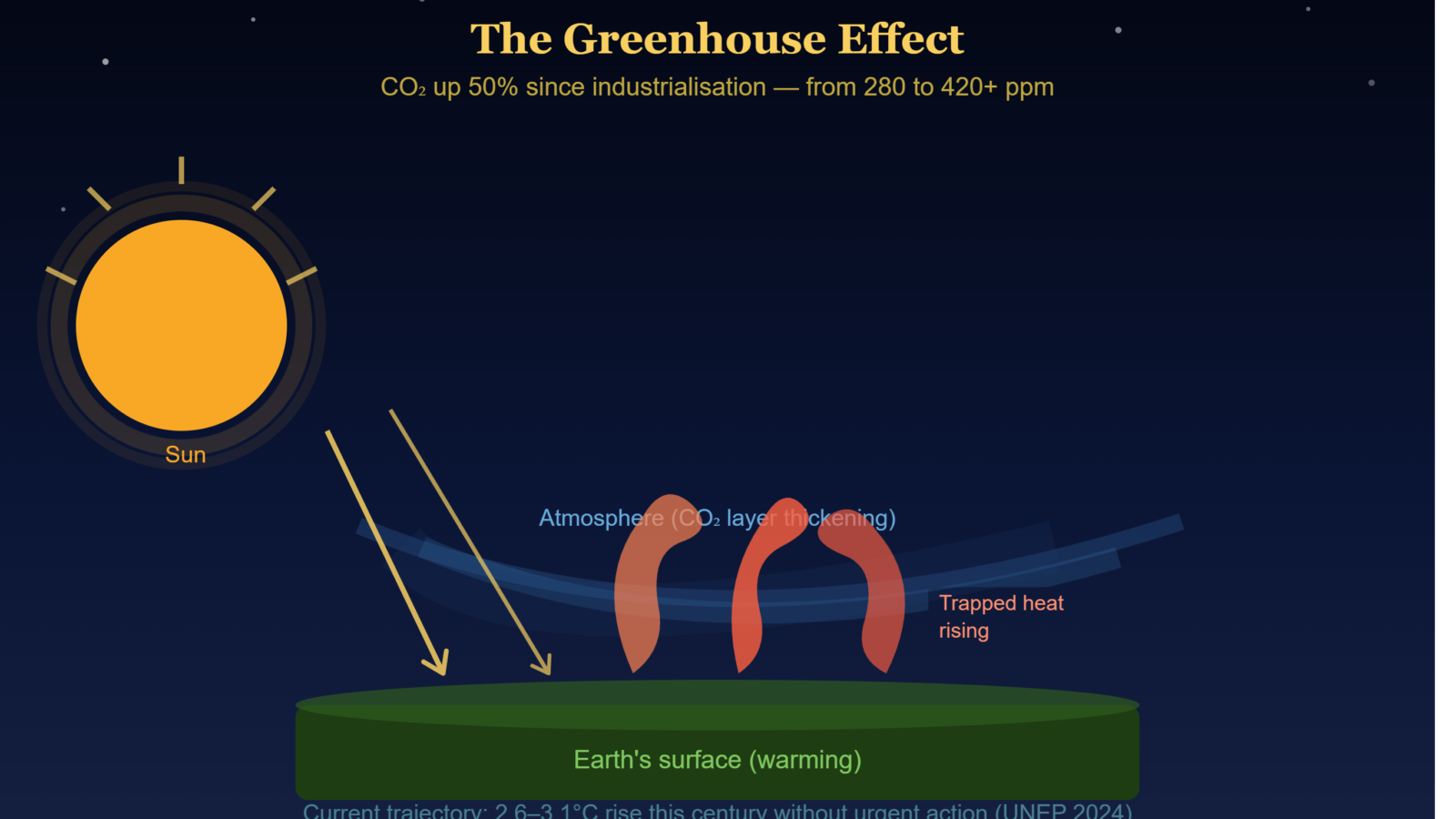
The Earth is naturally warmed by a process called the greenhouse effect. Sunlight passes through the atmosphere and warms the Earth’s surface. The surface then radiates heat back upward. Certain gases in the atmosphere — primarily carbon dioxide (CO2), methane (CH4), and water vapour — trap some of this outgoing heat, preventing it from escaping into space. This natural process is essential: without it, the Earth’s average temperature would be about -18°C, and life as we know it would not exist.
The problem is that human activities — primarily the burning of fossil fuels (coal, oil, and natural gas), deforestation, and certain agricultural practices — have dramatically increased the concentration of these greenhouse gases in the atmosphere. Since the Industrial Revolution, which began in the mid-18th century, atmospheric CO2 has risen from approximately 280 parts per million to over 420 parts per million — the highest level in at least 800,000 years, as determined by analysis of ice cores. The result is an intensified greenhouse effect: more heat is trapped, and the planet warms.
“To limit global warming to 1.5°C, greenhouse gas emissions must peak before 2025 at the latest and then decline 43% by 2030. Every fraction of a degree matters enormously.”
What Are the Main Causes?
The primary driver of contemporary climate change is the burning of fossil fuels, which accounts for approximately 73.7% of global greenhouse gas emissions according to the International Energy Agency and European Commission’s EDGAR database. Energy production for electricity and heat is the largest single sector, followed by transportation, industry, and agriculture. Deforestation is a major secondary driver: forests act as vast carbon stores, and when they are cleared — often for agriculture or urban development — the stored carbon is released into the atmosphere.
According to Nature Communications, the Global North is responsible for approximately 92% of excess historical carbon emissions. This historical context is essential: the concentrations of greenhouse gases accumulating in our atmosphere today are the product of over 150 years of industrialisation, predominantly in Europe and North America.
What Is Already Happening?
The impacts of climate change are not a future projection — they are a present reality. The Global Center on Adaptation reported that 2023 was the hottest year in recorded history. In 2024, human-caused climate change added 41 days of dangerous heat for billions of people globally. Sea levels are rising at accelerating rates. Arctic sea ice is declining. Glaciers are retreating. Extreme weather events — droughts, floods, wildfires, and powerful storms — are becoming more frequent and more intense, as confirmed by the science of climate attribution.
The Paris Agreement, the landmark 2015 international climate treaty now ratified by 194 parties, sets a global goal of holding temperature increases to “well below 2°C above pre-industrial levels” while pursuing efforts to limit warming to 1.5°C. The IPCC has made clear that crossing the 1.5°C threshold would dramatically increase the risk of severe and irreversible climate impacts — from coral reef collapse to accelerated ice sheet loss and more extreme heatwaves.
“No country, no community, and no generation is immune from the consequences of a warming planet. But the speed and the scale of our response will determine how severe those consequences become.”
What Happens If We Do Not Act?
The UNEP Adaptation Gap Report 2024 warns that without urgent action, the world is currently on course for a dangerous temperature rise of 2.6 to 3.1°C this century. At those levels, the consequences are severe and cascading: widespread coral bleaching and die-off; more powerful tropical cyclones; large-scale permafrost thaw releasing stored methane; agricultural collapse across large regions; and mass displacement of human populations. According to the World Bank, the ecological crisis at these temperatures could drive up to 135 million people into poverty by 2030.
Reason for Hope
Understanding climate change is the first step toward addressing it. The science is clear, the solutions are known, and the technology to implement many of them is already available. Renewable energy costs have plummeted over the past decade; solar and wind power are now among the cheapest sources of electricity in history. What is needed is the political will, financial commitment, and global cooperation to deploy these solutions at the scale and speed the crisis demands. Every individual, community, and nation has a role to play.
Key References
- IPCC — AR6 WGI: The Physical Science Basis (2021)
- UNFCCC — The Paris Agreement
- IEA / JRC-European Commission — Global GHG Emissions (EDGAR)
- Global Center on Adaptation — State and Trends 2024
- UNEP — Adaptation Gap Report 2024
- World Weather Attribution — Extreme Weather in 2024
- NASA — Key Climate Indicators
- NOAA — Climate.gov