SUMMARY
Across Africa, a new generation of young people is transforming climate education from a classroom subject into a community-led movement. This article traces the landscape of climate education on the continent, celebrates the faces driving change, and examines the structures — and gaps — that shape what is possible.
Africa is the world’s most climate-vulnerable continent, warming faster than the global average and home to a third of the countries most at risk from climate shocks. It is also home to the world’s youngest population — and it is from this demographic that some of the most compelling, creative, and urgent climate education initiatives are emerging. From Nairobi to Dakar, from Accra to Kigali, young Africans are not waiting for climate solutions to arrive. They are building them.
The Educational Landscape: Progress and Gaps
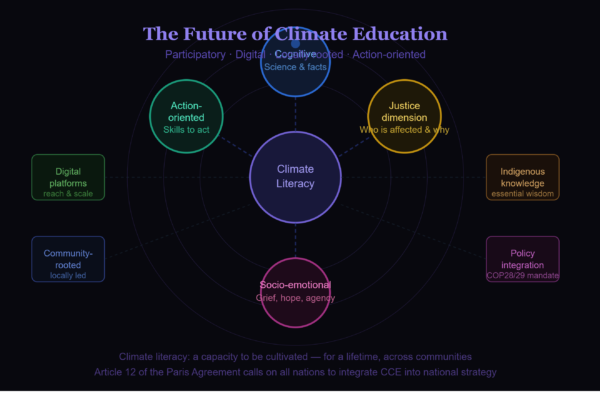
A 2025 academic study published in MDPI Sustainability found that climate change education (CCE) has been increasingly integrated into African curricula since the 1992 UNESCO Education for Sustainable Development agenda. However, a UNESCO Global Education Monitoring Report (2023) noted that most African universities and institutions have made progress primarily in the cognitive dimensions of climate education — the factual, scientific content — while giving far less attention to the socio-emotional, action-oriented, and justice dimensions that actually change behaviour and build lasting commitment.
This matters enormously. Research led by CARE Zimbabwe and conducted across Malawi, Kenya, Rwanda, South Africa, and Zimbabwe found that adolescents and youth are learning best about climate through play-based, community-rooted approaches — drama performances, songs, tree-planting campaigns, waste management clubs, radio programmes, and community meetings. Schools remain the primary gateway to climate information, but the approaches that matter most extend far beyond the classroom.
“Africa’s youth are not just the inheritors of the climate crisis — they are the innovators, the educators, and the negotiators who will determine its outcome. Investing in their climate literacy is among the highest-return actions the world can take.”
Young Leaders on the Frontlines
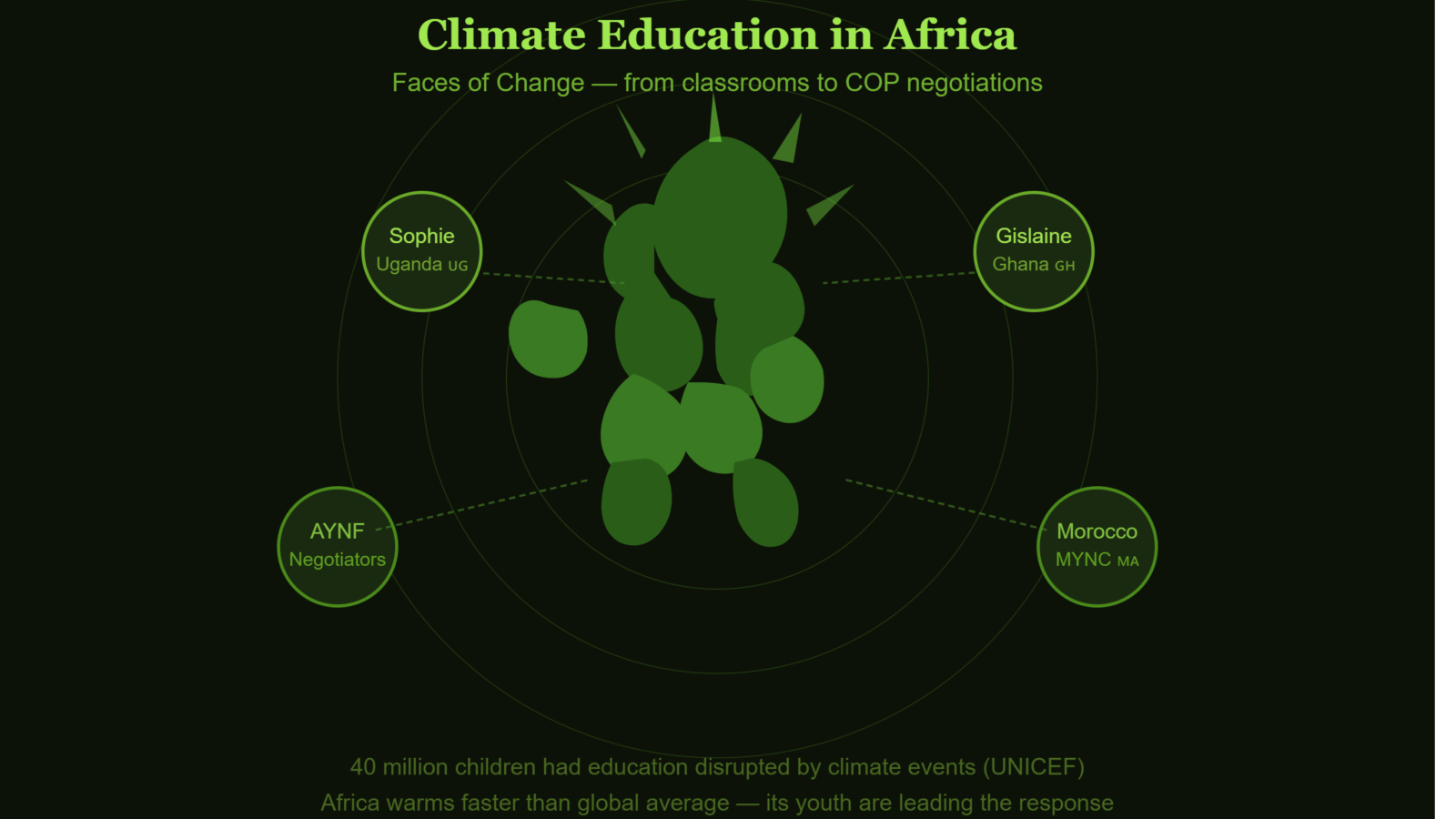
Sophie Nabukenya of Uganda is one such face of change. A girls’ rights advocate, poet, and artivist, Sophie has led two global campaigns — “Girls Get Equal” and “Let’s Change the Story” — reaching over 10 million people across social and mainstream media. She has incorporated gender and climate migration perspectives into Uganda’s Health National Action Plan on Climate Change, demonstrating how youth advocacy can influence national policy.
Gislaine, a young Ghanaian engineer and climate advocate, has made recycling and plastic education her central mission, working through volunteer networks to reach youth and communities across her home country. Her story reflects a broader pattern: young Africans identifying local environmental problems and building local solutions, often with minimal institutional support.
These individuals are not anomalies. The African Youth Climate Hub, operating since the early 2020s, catalyses youth-led climate projects across the continent, connecting innovators with mentors, resources, and markets. The African Youth4Climate (AY4C) initiative, launched at COP26 in Glasgow, now operates as a formally registered continental umbrella association spanning multiple African countries, bringing together youth leaders, NGOs, green enterprises, and civil society organisations.
From Classrooms to Climate Negotiations
African youth are not only working at the grassroots — they are increasingly entering the rooms where global decisions are made. The African Youth Negotiators Fellowship (AYNF), now in its fifth cohort, prepares young climate leaders to participate actively in UN climate governance, equipping them with both technical expertise and strategic negotiation skills. Organised by the Green Africa Youth Organization (GAYO) in collaboration with Ghana’s Environmental Protection Authority and the Climate and Development Knowledge Network (CDKN), the fellowship represents a significant investment in African youth leadership in international climate diplomacy.
In Morocco, the Moroccan Youth Negotiators Council (MYNC) — born from dialogues between youth organisations and the Ministry of Energy Transition — organised a Regional Conference of Youth in 2024, uniting over 250 young people from 45 African nations. The gathering culminated in the African Youth Climate Statement, a set of youth-driven recommendations that shaped the agenda at COP29. According to the 2024 Afrobarometer survey, 80% of Moroccans aged 18 to 25 had heard of climate change — a sign that youth climate awareness is deepening rapidly.
“Climate education in Africa is deeply rooted in community engagement and storytelling. Adolescents often learn through drama, song, and community meetings — approaches that are not only more effective but more culturally resonant.”
Digital Technology and Indigenous Knowledge: A Synthesis
The most forward-looking climate education programmes in Africa are drawing on two powerful resources: digital technology and indigenous knowledge systems. Digital tools — mobile learning platforms, social media campaigns, online fellowships like EcoChampions Africa’s Climate Education Leaders Fellowship (CELF) — are extending the reach of climate education to rural communities and young people without access to formal tertiary education. Meanwhile, indigenous knowledge systems offer time-tested insights into seasonal patterns, ecosystem management, and sustainable land use that are proving invaluable for climate adaptation.
A 2025 MDPI study argues that integrating digital technology with indigenous knowledge into CCE programmes is one of the most promising pathways for building truly contextual, culturally resonant, and practically actionable climate literacy among African youth.
The Stakes of Getting It Right
The stakes of climate education in Africa are not abstract. UNICEF estimates that 40 million children had their education disrupted as a result of climate-related disasters — school closures caused by flooding, heatwaves that render classrooms unsafe, cyclones that destroy school buildings. A third of the countries most vulnerable to climate shocks are in Eastern and Southern Africa. Without climate-literate communities capable of adapting, advocating, and innovating, these vulnerabilities will deepen with every passing decade. Climate education in Africa is not a peripheral concern. It is a frontline intervention.
Key References
- MDPI Sustainability — Climate Change Education: Preparing African Youth (2025)
- Brookings — Adolescents and Climate Education in Eastern and Southern Africa (2026)
- IOM — African Youth at the Crossroads of Climate Change Mobility
- Carnegie Endowment — Youth and Climate Change in MENA (2025)
- African Youth Climate Hub
- African Youth4Climate (AY4C)
- African Youth Negotiators Fellowship (AYNF)
- EcoChampions Africa — Climate Education Leaders Fellowship (CELF)
- Springer Nature — Climate Change Education in African HEIs (2024)
- UNICEF — Strategy for Climate-Resilient Education Systems (2025)