
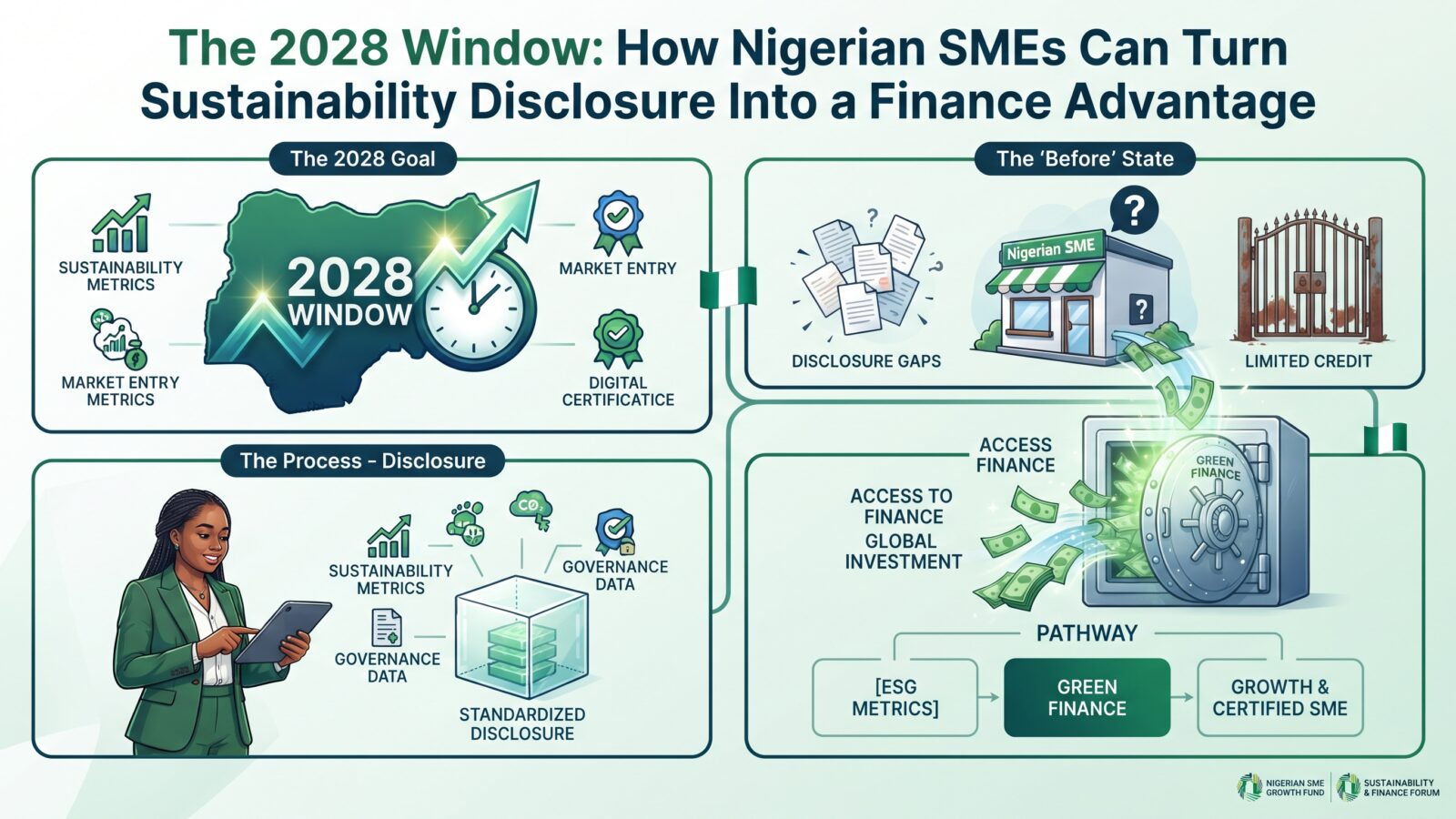
There is a quiet regulatory shift taking place in Nigeria that will reshape how businesses of every size access capital, negotiate contracts, and defend their market position over the next five years. Most Nigerian SMEs I speak to have not yet heard about it. The ones who have are, in the main, treating it as a future problem. Both responses are, in my view, a mistake and one that will become very expensive to correct after the window has closed.
The shift is this. The Financial Reporting Council of Nigeria (FRCN), building on Nigeria’s status as the first African country to commit to the International Sustainability Standards Board’s IFRS S1 and IFRS S2 sustainability disclosure standards, has issued a four-phased adoption roadmap. Voluntary adoption began in 2024. Mandatory sustainability and climate-related disclosure begins for Public Interest Entities (PIEs) — listed companies, banks, insurers, and other major public entities — from 1 January 2028. It extends to small and medium-sized enterprises from 1 January 2030, with wider public-sector and government body integration continuing into 2031.
In plain language: within roughly two years, every major Nigerian business your SME sells to, buys from, banks with now, or hopes to partner with will be legally required to disclose its sustainability and climate-related performance and increasingly, the performance of its supply chain. Within roughly four years, that same requirement will apply directly to your SME. The window between now and January 2028 is not a delay. It is a leverage opportunity. And the businesses that recognise it as such will unlock competitive positions that the late adopters will spend the next decade trying to catch up to.
Why this is about finance, not just paperwork
It is tempting to read sustainability disclosure as a compliance exercise. That reading understates what is actually happening. The reason the FRCN adopted IFRS S1 and S2 and the reason ISSB standards are being adopted by 30 jurisdictions representing 57% of global GDP — is that global capital markets have decided sustainability data is now decision-useful financial information. Banks are using it to price loans. Development finance institutions are using it to screen investments. International buyers are using it to qualify suppliers. Insurers are using it to set premiums. And increasingly, local Nigerian lenders and institutional investors are following the same trajectory.
This means the disclosure regime is, in effect, a finance-unlocking mechanism. Businesses that can credibly evidence their sustainability performance will access capital on better terms, qualify for contracts closed to their competitors, and enter export supply chains that require disclosure as a prerequisite. Businesses that cannot will find themselves quietly excluded not through explicit refusal, but through the slower and more damaging route of consistently losing to competitors who can show the numbers. For a Nigerian SME, particularly one hoping to grow, secure development finance, supply a listed company, or trade internationally, the sustainability leverage is not a nice-to-have. It is becoming a threshold condition for continued access to capital.
The opportunity for the proactive
For SMEs and business owners who use the current voluntary window well, the opportunities are significant.
- The first is cost of capital. Businesses that begin to measure, manage, and disclose their sustainability performance now will be positioned to negotiate better financing terms as lenders and investors integrate ESG factors into their pricing models. Green loans, sustainability-linked facilities, and blended finance instruments are already available to Nigerian businesses that can evidence performance credibly. The proactive SME becomes the preferred borrower.
- The second is supply chain positioning. As Nigerian PIEs come into mandatory disclosure in 2028, they will be under pressure to report the sustainability performance of their supply chains — Scope 3 emissions, supplier practices, community impact. SMEs that can already provide this data become the preferred suppliers overnight. The ones who cannot are quietly replaced.
- The third is export and international market access. The EU’s Corporate Sustainability Reporting Directive, the UK’s Sustainability Disclosure Requirements, and equivalent regimes across the world are increasingly demanding sustainability disclosure from the businesses their companies buy from. Nigerian SMEs with credible disclosure are export-ready. Those without it are locked out of markets they may not even know they are being screened for.
- The fourth is reputational and brand advantage. Nigerian consumers, particularly younger ones, are increasingly making purchasing decisions on the basis of perceived sustainability performance. Being early on this journey builds trust that late adopters cannot buy their way into.
The danger for the unprepared
The mirror image of these opportunities is the danger for SMEs who wait. The 2028 and 2030 deadlines are not distant. Systems, data, and reporting capabilities of the kind ISSB standards require cannot be assembled in a quarter. They take eighteen to thirty months of disciplined work to build the systems well in place. An SME that begins in mid-2028 is already too late for its 2030 deadline and will have spent two years watching competitors take the contracts, loans, and supply relationships it could have been positioned for. The risk is not a regulatory fine. It is being invisible to the capital and contracts that will define the next decade of Nigerian business. That is a slower, quieter, and far more damaging loss.
Four actions Nigerian SMEs can take now…
For SMEs and business owners reading this, four practical steps are worth beginning immediately.
- First, understand your baseline. You cannot improve or disclose what you have not measured. Begin with a simple materiality assessment, determing which sustainability and climate issues genuinely affect your business, and which does your business affect. Then start collecting basic data: energy use, water use, waste, workforce composition, supply chain origins. This does not require a consultant on day one; it requires discipline.
- Second, get familiar with IFRS S1 and IFRS S2. These are the standards that will govern the disclosure regime you will eventually be reporting into. Even at a summary level, understanding what they ask for — governance, strategy, risk management, and metrics and targets for sustainability and climate will shape the systems you build now so they are fit for purpose later.
- Third, integrate sustainability into your governance, not just your operations. ISSB standards ask for evidence that sustainability is being managed at board and leadership level — not delegated to a junior officer. Begin the culture shift now. Add sustainability to leadership meeting agendas. Assign senior accountability. Document decisions.
- Fourth, engage your value chain. Talk to your bank about sustainability-linked finance products. Talk to your major customers about the disclosure requirements they will soon be placing on their supply chain. Talk to your industry association about collective preparation. The SMEs who move early inside a network of similarly-moving peers make faster progress at lower cost than those who try to go it alone.
A closing reflection
Nigeria has, quietly, positioned itself as one of the first movers globally on sustainability disclosure. That gives Nigerian businesses an unusual opportunity, the chance to build compliance capability inside a supportive national framework, ahead of the market pressures that will eventually make it non-negotiable.
The businesses that use this window as leverage will find themselves better financed, better connected, and better positioned than their competitors when the mandatory regime arrives. The businesses that treat 2028 as a distant date will discover, uncomfortably, that it was never distant at all. The window is open now. It will not remain open indefinitely. And the cost of walking through it late is significantly greater than the cost of walking through it early.
About the Author
Oluwafemi Ajayi, is a Climate and Sustainability Professional working across community-generated renewable energy, nature-rich and resilient cities, and sustainability intiatives for climate action. He offers guidance and advisory to Nigerian SMEs, business owners, and organisations on how to begin taking practical action ahead of the 2028 and 2030 sustainability disclosure deadlines from baseline measurement and materiality assessment to governance integration and sustainability-linked finance readiness. If your business is exploring how to turn the coming disclosure regime into a competitive advantage, I’d be glad to have a conversation. Reach me on LinkedIn or via my website.
I’d be interested to hear from Nigerian SME owners, sustainability professionals, and finance leaders: where are you seeing this shift being taken seriously, and where is it still being underestimated?