
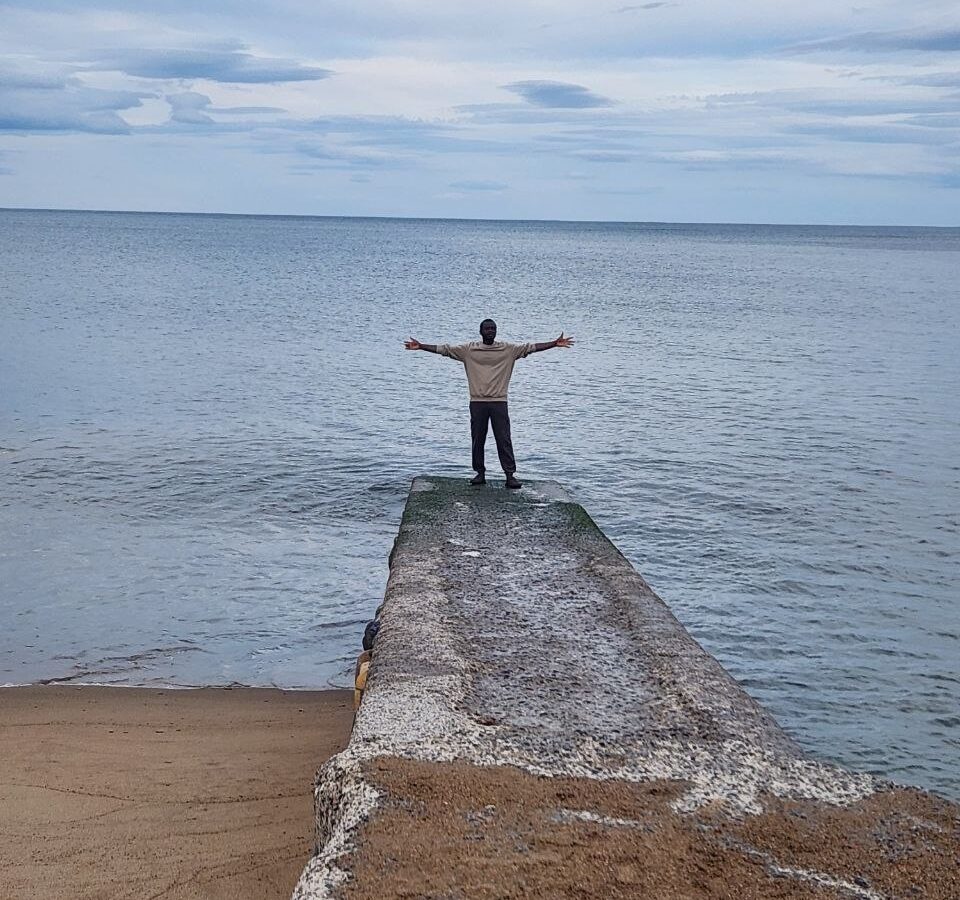
An evening walk, and a very large thought.
I found a new hobby, taking a slow evening walk along the shoreline. Nothing serious, just a chance to let the day settle before it ended. It was one of those walks where the mind stops chasing the next task and starts noticing the world in front of it. The tide moving without effort. The horizon further than any human structure I had passed all day. The sheer, quiet vastness of the water.
And somewhere in that quiet, a thought settled with me that I have not been able to put down since. This ocean as enormous, patient, and unfathomably vast body of water is one of the most important tools our planet has for managing the carbon we, as a species, keep releasing into the atmosphere. It draws down our excess carbon in ways no engineered technology has yet come close to matching. It buffers our climate every single day. And it does all of this while we, in most of the world, still treat it as somewhere between a resource to extract from and a dumping ground to forget about.
The trees part their part as well. Forests, peatlands, mangroves, grasslands, each of these terrestrial systems quietly sequesters carbon in the background of daily life, and much of our climate policy is rightly focused on protecting and restoring them. But standing at the shoreline that evening, it struck me how one-sided our public conversation about carbon sinks has become. We speak often, and rightly, about trees but we speak far less about the ocean. And the ocean, it turns out, has been carrying more of the weight than most people even realise.
I want to use this article to sit with that imbalance and to look honestly at what the ocean is doing for our carbon cycle balance, what our behaviour is costing it in return, and what a serious approach to ocean management would ask of us.
What the ocean is quietly doing for us…
The scale of the ocean’s contribution to our carbon cycle is genuinely staggering. According to the United Nations and multiple peer-reviewed studies, the ocean absorbs somewhere between 25 – 31% of all the carbon dioxide humanity releases into the atmosphere each year. It also captures roughly 90% of the excess heat trapped by our greenhouse gas emissions. And it produces around half of the oxygen we breathe. I want you tead those numbers slowly again. Nearly a third of our carbon emissions. Nine-tenths of our excess heat. Half of our oxygen.
Without the ocean absorbing carbon and heat at this scale, the warming we have already experienced would be dramatically greater, and the timeline for climate impact would be much shorter than the one we are currently, imperfectly, adapting to. The ocean has, in effect, been buying humanity time, acting as a buffer of decades, perhaps generations while we have been slow to reduce the emissions causing the problem in the first place. That is a debt worth naming. And it is a debt we are, in several serious ways, failing to honour.
Three consequences of how we are treating the ocean
Our activity is not neutral to the ocean’s carbon-cycle role. The way we are living, extracting, polluting, and warming the planet is quietly degrading the very system that has been protecting us for decades. Three consequences of our actions in particular have stayed with me since that walk.
1. Warmer ocean temperatures
As the ocean absorbs the excess heat from our greenhouse gas emissions, its own temperature rises. In principle this is the ocean doing its job. In practice, it is the ocean losing its capacity to keep doing that job effectively. The science teaches us that warmer water absorbs less carbon dioxide than cooler water and that is a basic physical fact of gas solubility. The warmer the ocean gets, the less carbon it can draw down from the atmosphere per unit volume. So the very success of the ocean as a heat sink is quietly undermining its effectiveness as a carbon sink.
Warmer waters also disrupt the biological systems that participate in ocean carbon storage. Coral reefs, plankton communities, seagrasses, mangroves, and the wider food webs they support are all sensitive to temperature. Marine heatwaves, which have grown longer, more intense, and more frequent in the last decade are killing coral reefs at a scale we have not previously observed, weakening the biological pump that moves carbon from the surface ocean to the deep. In other words, warming the ocean does not just heat it. It weakens it.
2. Ocean acidification
When the ocean absorbs carbon dioxide, that carbon does not sit inertly in the water. It reacts. Dissolved CO₂ combines with seawater to form carbonic acid, and the resulting shift in ocean chemistry is what we call ocean acidification. Global surface ocean pH has already dropped by roughly 0.1 units since the industrial revolution which is a change that sounds small until you remember the pH scale is logarithmic, which means the ocean is now around 30 percent more acidic than it was a few centuries ago.
The consequences ripple outward. Shell-forming organisms such as corals, oysters, mussels, pteropods, and many of the microscopic plankton at the base of the marine food web now struggle to build and maintain their calcium carbonate skeletons in more acidic water. When those foundational organisms weaken, the food chains built on top of them weaken with them. And so does the biological carbon pump that quietly moves atmospheric carbon into long-term storage on the sea floor. Acidification is, in a real sense, the ocean’s slow, chemical response to being asked to absorb more than it was ever designed to and every tonne of CO₂ we continue to emit deepens the response.
3. Melting permafrost and thawing ice releasing methane
The third consequence is different in character, and I also think is well under-discussed. As global temperatures rise, the world’s permafrost, the vast frozen soils of the Arctic and sub-Arctic is beginning to thaw. So are the seabed sediments in shallow polar waters that have been frozen for tens of thousands of years. Locked inside those frozen soils and sediments is an enormous quantity of organic carbon, much of it in the form of methane hydrates and decomposing biological material. As the ice retreats and the ground warms, that carbon is being released back into the atmosphere as methane, a greenhouse gas roughly 28 to 30 times more potent than CO₂ over a hundred-year timescale, and even more potent in the short term.
Recent studies of thermokarst lakes on the Tibetan Plateau and across the Arctic have shown that methane release during ice-melt periods has been consistently underestimated. These lakes, which cover a tiny fraction of the permafrost area, are already releasing significant volumes of methane, and their emissions are projected to more than double by the end of the century as thaw accelerates. This is what climate scientists call a feedback loop. Human emissions warm the planet. The warming thaws frozen carbon stores. The thawing releases more greenhouse gases. Those gases warm the planet further. And each turn of the loop makes the next turn faster. Crazy right?
The ocean and its polar systems are at the heart of this feedback. Which is why what happens to them is not a niche concern for marine scientists alone but a concern for anyone who cares whether the climate stabilises in this century.
What serious ocean management would ask of us…
If we take seriously the ocean’s role in our carbon cycle, then the way we treat it needs to shift from casual disregard to intentional stewardship. I would offer four directions.
First, drastically reduce ocean pollution. Plastic waste, chemical runoff from agriculture, untreated sewage, and industrial discharge are all weakening marine ecosystems that participate in carbon storage. Cleaner waters support healthier plankton communities, healthier fisheries, and healthier coastal blue-carbon ecosystems. Every effort to reduce what we dump into the ocean is, indirectly, an effort to protect its carbon-cycle function.
Second, protect and restore coastal blue-carbon ecosystems. Mangroves, saltmarshes, seagrass beds, and kelp forests store carbon at densities that rival or exceed tropical rainforests. They also protect coastlines, support fisheries, and buffer storm surges. Yet many of these ecosystems have been lost or degraded in recent decades. Their restoration is one of the highest-leverage climate interventions available to coastal nations and one of the most under-funded.
Third, manage fisheries and seabed extraction responsibly. Overfishing, bottom trawling, and unregulated deep-sea mining all disturb the biological and physical processes that move carbon from the surface ocean to deep storage. Sustainable fisheries management, marine protected areas, and strong precautionary rules on deep-sea extraction are climate policy worth addressing, whether or not they are labelled as such.
Fourth, and most importantly, reduce emissions at source. No amount of ocean management can substitute for a serious global reduction in greenhouse gas emissions. The ocean cannot solve a problem we keep making larger. Every strategy to protect the ocean’s carbon-cycle role is a strategy to buy time time that only matters if we use it to decarbonise the systems producing the emissions in the first place.
A closing reflection
I have thought about that walk many times in the days since. Standing at the edge of something so vast and boundless, so patient, and so quietly generous, it was difficult not to feel a mix of gratitude and unease. Gratitude for what the ocean has been doing on our behalf, decade after decade, without recognition. Unease at how casually our species has been treating something so essential.
The trees do their part. And we are, at last, beginning to speak seriously about protecting them. But if we want a carbon cycle that stays within liveable limits this century, we cannot afford to speak about the ocean any less seriously than we speak about the forest. It has been carrying more of us, for longer, than most of us know. The least we can do, in return, is stop treating it as somewhere to look away from and start treating it as the climate ally it has always been.
I’d be interested to hear from those working in marine science, coastal management, sustainability, or climate policy: where do you think the conversation about ocean stewardship most needs to catch up with what the science already tells us?